
www.ptreview.co.uk
03
'26
Written on Modified on
Miniature Sensors for Robot Gripper Position Monitoring
Contrinex develops compact sensing technologies for precision automation, supporting collision prevention and position verification in robotic handling systems.
www.us.contrinex.com
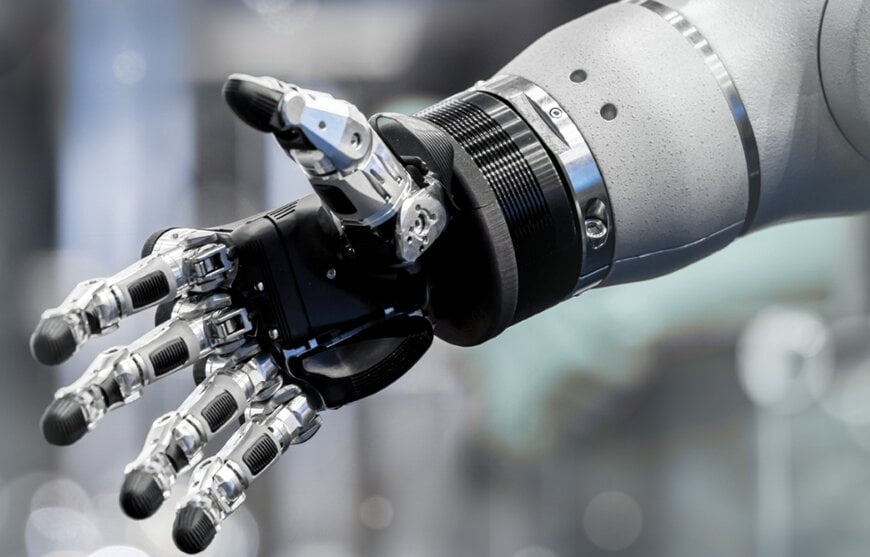
Contrinex has developed a range of miniature inductive and photoelectric sensors designed to provide precise gripper position detection and obstacle sensing in applications where installation space is limited and operational reliability is critical.
Sensor-Based Position Control in Robotic Handling Systems
Modern robotic handling systems increasingly operate in environments where small positioning errors can result in product damage, production interruptions, or equipment collisions. This challenge is particularly evident in the solar industry, where robot grippers transfer fragile silicon wafers between processing stations.
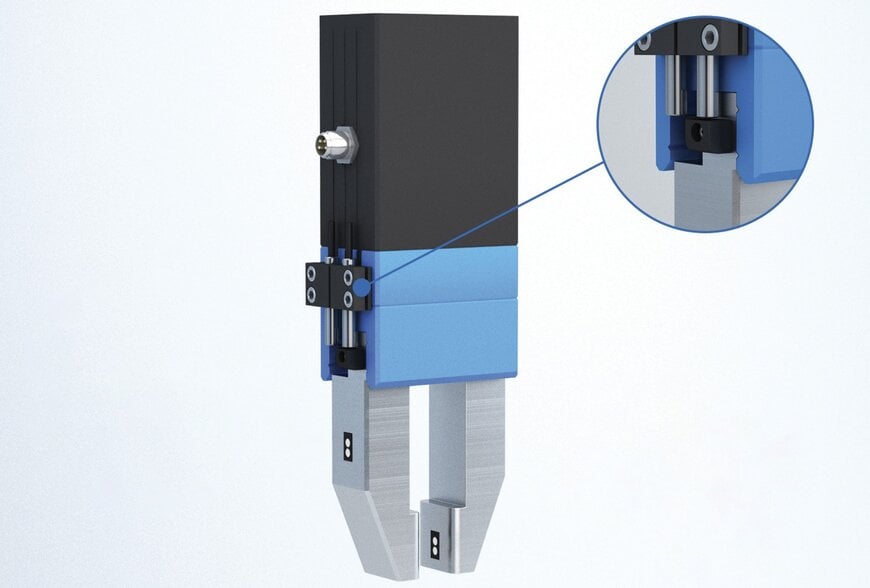
If gripper jaws fail to reach their fully open position before approaching a wafer, contact can damage or destroy the component. Accurate monitoring of jaw position therefore plays an important role in maintaining process reliability and product quality.
Contrinex addresses this requirement through miniature inductive sensors capable of monitoring both the opening angle and the exact position of robot gripper jaws during operation.
High-Speed Inductive Sensing for Precision Automation
The inductive sensor range is designed for applications requiring rapid response times and compact integration. The sensors support switching frequencies of up to 8,000 Hz, enabling position monitoring in high-speed automation environments.
With dimensions of only 3 mm × 12 mm, the sensors can be integrated into confined mechanical assemblies where larger sensing devices would be impractical. Temperature stability is specified from −25°C to +70°C or up to +85°C, depending on the model, supporting deployment in a variety of industrial operating environments.
The product family includes several configurations optimized for different operating conditions. The Minimini version provides sensing distances of up to 1 mm, while the Full Inox version incorporates a one-piece stainless steel housing manufactured from AISI 304 material and offers pressure resistance up to 120 bar. The Extra Distance variant provides sensing ranges up to four times greater than those of standard inductive sensors.
Photoelectric Sensors for Collision Prevention
In addition to position monitoring, robotic systems often require obstacle detection to prevent unintended contact between moving equipment and surrounding objects.
Contrinex's photoelectric miniature sensors are designed to support collision avoidance functions in robot grippers and automated handling systems. The sensors use a focused LED red-light source with a 5 mm light spot to measure distances to both metallic and non-metallic targets.
The sensing system incorporates an analog output ranging from 0.1 VDC to 2.6 VDC and an adjustable PNP light output, allowing integration into a wide range of industrial control architectures. Their compact design enables full installation within machine structures, minimizing exposure to mechanical damage.
Optical and ASIC Technologies for Compact Sensor Integration
The photoelectric sensors combine optical measurement technology with application-specific integrated circuits (ASICs) to process distance and target detection data within a small form factor.
Availability in both housed and housing-free configurations provides flexibility for machine builders developing customized robotic systems. Such adaptability is particularly relevant in precision automation sectors where sensor placement must be optimized around moving mechanical components.
Supporting IIoT-Enabled Industrial Automation
As manufacturers continue to deploy Industrial Internet of Things (IIoT) architectures, sensors increasingly serve not only as safety and control devices but also as sources of operational data.
Contrinex's miniature sensor portfolio includes IO-Link-capable models that can support digital communication, diagnostics, and parameterization within connected automation systems. This capability allows sensor data to be integrated into broader machine monitoring and predictive maintenance strategies.
By combining compact dimensions, high switching frequencies, obstacle detection functions, and digital connectivity, the sensors address the growing demand for intelligent sensing solutions in robotic handling, precision assembly, electronics manufacturing, and renewable energy production environments.
Additional Context
This section details technical specifications and competitive benchmarking not included in the original news release.
The market for miniature industrial sensors includes suppliers such as SICK, Pepperl+Fuchs, Balluff, ifm, Turck, Omron, and Keyence.
Switching frequencies of up to 8,000 Hz place the inductive sensors among the higher-speed devices available for precision automation applications. In robotic gripper monitoring, high switching frequency is an important performance metric because it enables accurate position tracking during rapid mechanical movements.
The compact dimensions of 3 mm × 12 mm are also notable when compared with conventional industrial proximity sensors, which often require significantly larger installation spaces. This characteristic is particularly relevant in semiconductor manufacturing, electronics assembly, medical device production, and solar wafer handling systems, where machine components are densely packed.
The integration of IO-Link connectivity aligns with broader Industry 4.0 and IIoT trends. Comparable sensor platforms increasingly support digital diagnostics and real-time condition monitoring, enabling manufacturers to incorporate sensing devices into connected automation architectures while improving maintenance visibility and system performance.
Edited by Aishwarya Mambet, Induportals Editor, with AI assistance.
www.contrinex.com
