
www.ptreview.co.uk
22
'26
Written on Modified on
Heavy-Duty Robot Enhances Safety in Hazardous Energy Environments
ADNOC deploys an autonomous inspection system and co-develops a robotic platform capable of equipment handling in high-risk industrial operations.
www.adnoc.ae
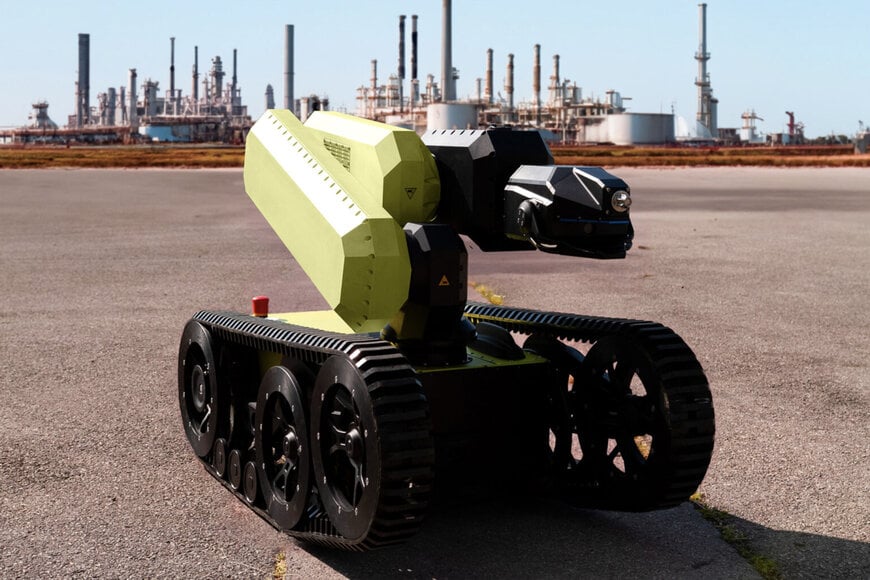
ADNOC has deployed Taurob’s heavy-duty inspection robot at the Taweelah Gas Compression Plant to perform autonomous inspections in hazardous operational environments. The company has also announced development of what it describes as the industry’s first heavy-duty operator robot, designed to manipulate industrial equipment remotely or autonomously while reducing the need for personnel exposure in high-risk areas.
The initiatives form part of ADNOC’s broader strategy to integrate AI, robotics and autonomous systems into energy operations to improve safety, operational reliability and industrial performance.
Autonomous inspection systems support hazard detection in gas facilities
The deployed Taurob inspection robot performs on-site autonomous monitoring using integrated sensor technologies including 3D LiDAR and thermal imaging with 360-degree visibility. The system is intended to identify abnormal conditions such as gas leaks, temperature anomalies and other operational hazards before they escalate into safety incidents.
Robotic inspection platforms are increasingly used in oil and gas environments where extreme temperatures, confined spaces and explosive atmospheres present risks to personnel. By operating as an autonomous first-response monitoring layer, such systems can extend inspection frequency while reducing direct human exposure.
Heavy-duty operator robot designed for industrial intervention tasks
Beyond inspection capabilities, ADNOC is collaborating with Taurob, Equinor, Petrobras, TotalEnergies, Saft and the Net Zero Technology Centre through the ARGOS Joint Industry Project to develop a heavy-duty operator robot capable of physical intervention tasks.
The planned system is designed to function in temperatures ranging from -20°C to 60°C and perform activities including lifting equipment, operating valves and handling gauges. These functions would traditionally require maintenance personnel to work within hazardous environments.
According to ADNOC, the robot will support both remote operation and autonomous execution modes, enabling maintenance activities without requiring continuous human presence in operational risk zones. The operator robot is expected to become operational by the end of 2026.
Industrial AI and robotics expand safety monitoring capabilities
The deployment aligns with ADNOC’s wider adoption of AI-enabled safety technologies. The company states its HSE Cockpit.ai platform has reduced safety incidents by 30% through real-time monitoring and predictive oversight intended to prevent operational risks before escalation.
ADNOC also uses robotics and drones for emissions monitoring, hazardous inspections and incident response across land, marine and aerial environments, including confined spaces and restricted operational zones.
The integration of AI oversight with autonomous robotics reflects a growing trend within energy infrastructure where predictive analytics and physical automation increasingly operate together to support industrial safety and asset reliability.
Additional Context
Technical specifications and competitive benchmarking not included in the original product announcement
Industrial inspection and intervention robots for energy infrastructure compete with platforms from Taurob, Boston Dynamics and ANYbotics, where benchmark criteria commonly include autonomous navigation capability, environmental tolerance, payload capacity, sensor integration and suitability for hazardous environments. Existing systems such as Boston Dynamics’ Spot and ANYbotics’ ANYmal are widely used for inspection tasks but are primarily optimized for mobility and monitoring rather than heavy-duty manipulation.
The planned ADNOC-Taurob operator robot differentiates through combining autonomous inspection with physical intervention capabilities, including valve operation and heavy equipment handling across temperatures from -20°C to 60°C. Multi-function robotics capable of both inspection and industrial manipulation remain less common in oil and gas operations, where inspection and intervention systems are often deployed separately.
Edited by Natania Lyngdoh, Induportals editor, assisted by AI.
www.adnoc.com
