
www.ptreview.co.uk
19
'26
Written on Modified on
Embedded AI Computing for Autonomous Robotics
Vecow Co., Ltd. will showcase embedded AI computing platforms and robotics development systems for humanoid robots, AMRs, and industrial autonomous systems at Robotics Summit & Expo 2026.
www.vecow.com
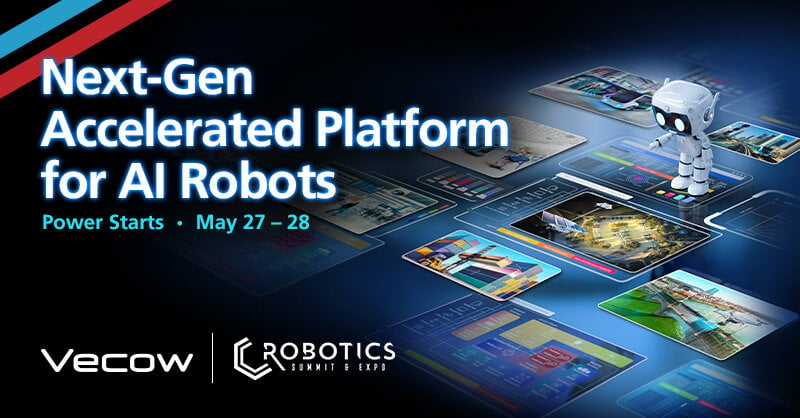
Vecow Co., Ltd. announced that it will present a portfolio of AI robotics platforms and edge computing systems at Robotics Summit & Expo 2026, scheduled for May 27–28 at the Boston Convention and Exhibition Center in the United States. The company is focusing on embedded AI infrastructure, autonomous robotics systems, and industrial edge computing technologies designed for commercial robotics applications.
The portfolio targets multiple robotics sectors, including humanoid robotics, autonomous mobile robots (AMRs), industrial automation, machine vision, and next-generation physical AI systems.
High-performance AI computing for humanoid robotics
The central platform in Vecow’s exhibition is the EAC-7000 Series, an AI computing system based on the NVIDIA Jetson Thor platform and Blackwell GPU architecture. The system integrates 128 GB of memory and delivers up to 2,070 FP4 TFLOPS for generative AI and robotics workloads requiring large-scale parallel processing.
The platform supports up to 16-channel GMSL camera input streams to enhance environmental perception and real-time situational awareness in autonomous systems. These capabilities are relevant for robotics applications involving navigation, obstacle detection, sensor fusion, and machine vision.
The EAC-7000 Series is also integrated with NVIDIA Isaac for Mobility, enabling compatibility with robotics simulation, perception, and autonomy development frameworks commonly used in advanced robotic systems.
Generative physical AI for industrial robot control
Vecow will also demonstrate a metal processing automation platform powered by the ECX-3100 PEG system. The company describes the solution as an “Experience-Driven Robotic OS” designed to reduce robotic integration complexity in industrial environments.
According to Vecow, the platform improves robot tuning efficiency by 85% and enables deployment times of approximately 15 minutes for industrial automation tasks. The system also supports CAD-free path generation, allowing integration with multiple mainstream industrial robotic arms without requiring conventional CAD-based programming workflows.
These capabilities are intended for manufacturing environments where robotic deployment speed, reduced engineering complexity, and lower operational downtime are critical factors.
Edge AI platforms for AMRs and industrial autonomy
The company will additionally present the VTK AMR Development Kit based on the EDR-1000 Series. The turnkey platform is designed for developers building autonomous mobile robots while minimizing low-level hardware integration requirements.
Vecow will also showcase several edge AI product families targeting different industrial and mobile robotics scenarios.
The Panther Lake-based TGS-2000 Series focuses on energy-efficient mobile AI processing for robotics and autonomous systems.
The Arrow Lake-S ECX-4000 Series is designed for compute-intensive edge applications such as industrial AI analytics, machine vision, and collaborative robotics.
The Bartlett Lake-S 12P portfolio includes the VCM-2000, ECX-3000 PEG, RCX-3000 PEG, and EVS-3000 platforms intended for rugged industrial environments requiring continuous operation and high system reliability.
In addition, the Qualcomm-powered ACS-1000 and AIC-200 Series target lightweight mobile robotics applications requiring optimized performance-per-watt characteristics for edge AI processing.
Embedded AI infrastructure for commercial robotics
Vecow’s latest robotics portfolio reflects broader industry demand for embedded AI systems capable of processing sensor, camera, and navigation data locally in real time. Such architectures are increasingly important in logistics automation, smart manufacturing, warehouse robotics, autonomous inspection systems, and humanoid robotics.
The Robotics Summit & Expo 2026 event will bring together developers and manufacturers focused on commercial robotics, industrial AI infrastructure, and autonomous mobility technologies.
Additional Context: Technical Specifications and Competitive Benchmarking
The NVIDIA Jetson Thor platform used in the EAC-7000 Series targets robotics and edge AI applications requiring generative AI inference and multimodal perception processing. NVIDIA’s Blackwell GPU architecture is optimized for low-precision FP4 AI computation commonly used in large language models, robotics AI acceleration, and physical AI workloads.
Competing embedded robotics AI platforms include NVIDIA Jetson AGX Orin systems, Intel Edge AI platforms, and Qualcomm Robotics RB5 solutions. Benchmark comparisons in this segment typically focus on AI throughput measured in TOPS or TFLOPS, memory capacity, camera interface scalability, energy efficiency, and compatibility with robotics software ecosystems.
NVIDIA-based systems generally dominate high-performance humanoid robotics and generative AI applications due to GPU acceleration capabilities, while Qualcomm platforms are often positioned for power-efficient autonomous mobile systems and lightweight robotics deployments.
Edited by Sucithra Mani, Induportals editor – adapted by AI.
www.vecow.com
