
www.ptreview.co.uk
07
'26
Written on Modified on
Rugged CMOS camera platform for industrial imaging
STEMMER IMAGING introduces the Imperx Cheetah CMOS camera series for industrial, aerospace and defence imaging applications requiring high reliability and precision.
www.stemmer-imaging.com
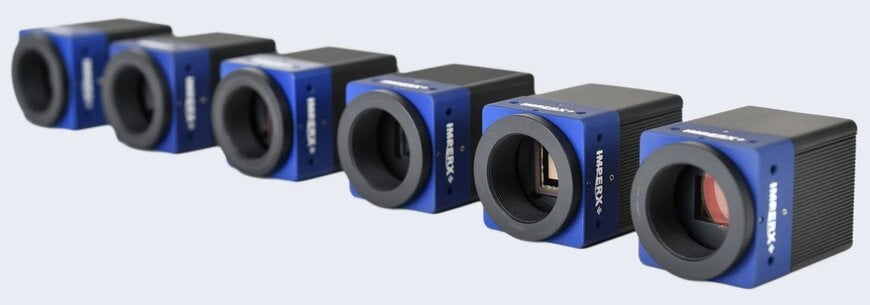
STEMMER IMAGING, as a newly authorized distributor and partner for Imperx, has introduced the Cheetah CMOS camera series, a rugged imaging platform designed for high-reliability applications in aerospace, defense, and precision industrial inspection.
The Cheetah CMOS series is built on the platform architecture that supported the Artemis II mission. A customized Imperx Bobcat CCD camera was utilized on the Space Launch System (SLS) rocket to verify booster separation dynamics under thermal extremes and spaceflight conditions.
The Cheetah series is compliant with MIL-STD-810G standards and operates within a temperature range of -30°C to +75°C, with select models supporting -40°C to +85°C. The units feature a Mean Time Between Failures (MTBF) exceeding 660,000 hours and are available with IP67-rated housing. The design prioritizes low power dissipation of less than 5W, allowing for conductive cooling without the need for forced-air systems.
Sensor Capabilities and Spectral Range
The series incorporates Sony Pregius and GPIXEL global shutter sensors with resolutions ranging from 1.6 MP to 65 MP. Beyond visible light, the portfolio includes Short-Wave Infrared (SWIR) variants covering 400–1,700 nm and Ultraviolet (UV) models covering 200–400 nm.
For imaging in uncontrolled lighting, the cameras offer a dynamic range of up to 80 dB, while specific models feature a smart WDR mode that exceeds 100 dB. This capability allows the system to manage variable lighting without auxiliary compensation hardware.
Interface and Software Integration
To facilitate integration into existing architectures, the Cheetah series supports multiple industry-standard interfaces:
- Camera Link and CoaXPress (CXP-6 and CXP-12)
- GigE Vision (PoE) and 10 GigE Vision over fiber
- USB3 Vision and 3G-SDI
The hardware is GenICam compliant, providing raw data access and compatibility with major SDK environments, including CVB Common Vision Blox. This enables engineering control over gain, exposure, Look-Up Tables (LUT), and corrections.
Sector-Specific Applications
- Semiconductor and Electronics: High-resolution 31.5 MP APS-C models resolve fine features on wafers and PCBs with low noise and high pixel uniformity.
- Logistics: Compact PoE models utilize on-camera auto-exposure and gain controls to adapt to variable sortation environments.
- Scientific Research: Supports long exposure times up to 16 seconds and 8, 10, or 12-bit output for low-light fluorescence and metrology.
- Defense and Surveillance: MIL-SPEC compliance and SWIR capabilities facilitate imaging through fog, haze, and for material differentiation in ground or airborne deployments.
Additional Context
The transition from CCD (Charge-Coupled Device) to CMOS (Complementary Metal-Oxide-Semiconductor) sensors in ruggedized imaging represents a significant shift in industrial and aerospace sectors. While CCDs historically offered superior uniformity, modern CMOS global shutter sensors, such as the Sony Pregius line, now provide higher frame rates and lower power consumption while maintaining the high dynamic range necessary for scientific applications.
Space-qualification involves rigorous testing beyond standard industrial requirements, ensuring components can withstand vacuum conditions, high radiation levels, and extreme pyrotechnic shocks during rocket stage separation. In terrestrial applications like semiconductor fabrication, high resolution and pixel uniformity are critical for Automated Optical Inspection (AOI) systems, where minor sensor noise can be misidentified as a wafer defect. Short-Wave Infrared (SWIR) imaging is particularly valued in defense because it can see through atmospheric obscurants like smoke and allows for the identification of specific chemical signatures in materials that are indistinguishable in the visible spectrum.
STEMMER IMAGING, based in Munich, has recently expanded its role as a value-added distributor for specialized imaging hardware following strategic acquisitions such as Phase 1 Technology in late 2024. This partnership with Imperx allows the distributor to offer mission-critical imaging solutions to the European and North American markets as industrial automation increasingly requires hardware capable of operating in non-climate-controlled environments.
Edited by Romila DSilva, Induportals Editor, with AI assistance.
The transition from CCD (Charge-Coupled Device) to CMOS (Complementary Metal-Oxide-Semiconductor) sensors in ruggedized imaging represents a significant shift in industrial and aerospace sectors. While CCDs historically offered superior uniformity, modern CMOS global shutter sensors, such as the Sony Pregius line, now provide higher frame rates and lower power consumption while maintaining the high dynamic range necessary for scientific applications.
Space-qualification involves rigorous testing beyond standard industrial requirements, ensuring components can withstand vacuum conditions, high radiation levels, and extreme pyrotechnic shocks during rocket stage separation. In terrestrial applications like semiconductor fabrication, high resolution and pixel uniformity are critical for Automated Optical Inspection (AOI) systems, where minor sensor noise can be misidentified as a wafer defect. Short-Wave Infrared (SWIR) imaging is particularly valued in defense because it can see through atmospheric obscurants like smoke and allows for the identification of specific chemical signatures in materials that are indistinguishable in the visible spectrum.
STEMMER IMAGING, based in Munich, has recently expanded its role as a value-added distributor for specialized imaging hardware following strategic acquisitions such as Phase 1 Technology in late 2024. This partnership with Imperx allows the distributor to offer mission-critical imaging solutions to the European and North American markets as industrial automation increasingly requires hardware capable of operating in non-climate-controlled environments.
