
www.ptreview.co.uk
06
'26
Written on Modified on
Integrating Digital Twin Simulation in Industrial Automation Lifecycle
KUKA Group and Visual Components collaborate to deploy high-fidelity simulation platforms for virtual commissioning and lifecycle management in manufacturing environments.
www.kuka.com
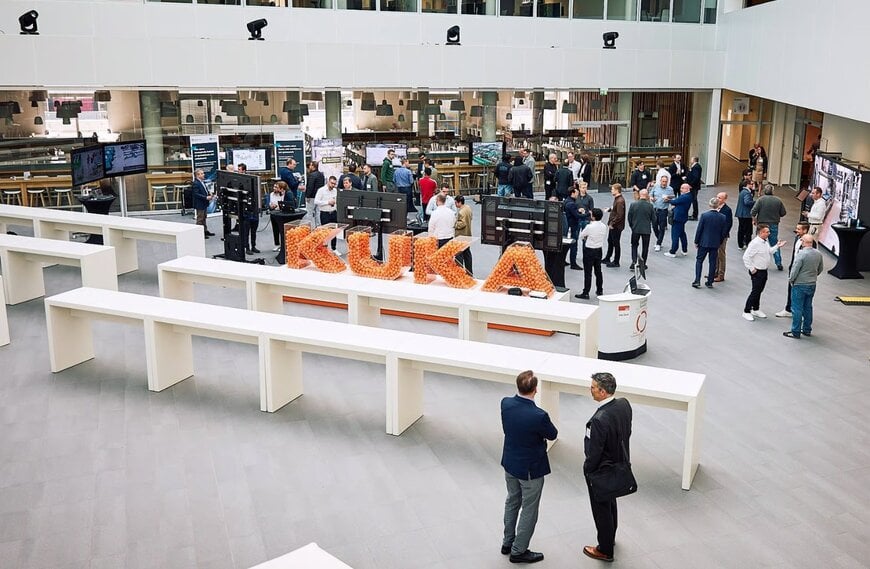
KUKA Group and its subsidiary Visual Components are integrating advanced simulation software into the industrial automation lifecycle to streamline the design, validation, and deployment of robotic systems. This cooperative approach targets the manufacturing and automotive sectors, utilizing digital twin technology to optimize production layouts and reduce operational risks.
Context of the Cooperation
As the global digital twin market expands, simulation has transitioned from an isolated engineering task to a strategic requirement for digital infrastructure. KUKA Group, a global supplier of automation solutions, utilizes Visual Components’ simulation expertise to provide a unified platform for system integrators and end-users.
The cooperation addresses the increasing complexity of modern production lines, where manual planning often leads to costly physical adjustments during installation. By combining KUKA’s hardware expertise with Visual Components’ software environment, the partners provide a framework for virtual testing before physical implementation.
Technical Solution and Responsibilities
The technical core of this cooperation is the Visual Components 5.0 platform. This software functions as a high-fidelity simulation environment that supports:
- Virtual Commissioning: Testing PLC code and robot logic against a digital twin to identify bottlenecks.
- Predictive Modeling: Quantifying cycle times and material flow parameters.
- High-Fidelity Digital Twins: Creating 3D representations of production cells that mirror physical kinematics and sensor data.
Visual Components provides the software architecture and the "eCatalog" product library, which includes component geometries and behaviors. KUKA integrates its robot controller data into this environment, ensuring that simulated movements align with real-world mechanical constraints.
Deployment and Ecosystem Integration
The solution is deployed across a broad partner ecosystem, including system integrators and technology providers such as Bosch Rexroth and BENTELER Automotive. Implementation phases involve the early-stage validation of layouts, followed by the integration of production data for continuous optimization.
At BENTELER Automotive, the platform is used to perform data-driven analysis of production cells, shortening development cycles. Bosch Rexroth utilizes the system to expand its digital engineering toolchain, ensuring that mechanical automation and software control are synchronized through standardized interfaces.
Operational Impact and Industrial Application
The primary application areas include industrial automation and large-scale manufacturing. By utilizing a shared simulation platform, companies report improved process stability and faster time-to-market.
“With Visual Components, we are empowering our customers and partners to reduce risk and unlock new levels of efficiency across the entire automation lifecycle,” states Christoph Schell, CEO of KUKA Group.
The integration enables manufacturers to visualize major investments and validate robot concepts at an early stage. This reduces the necessity for physical prototypes and minimizes downtime during the ramp-up phase of production, contributing to more resilient and flexible manufacturing systems.
Edited by Evgeny Churilov, Induportals Media - Adapted by AI.
www.kuka.com
Deployment and Ecosystem Integration
The solution is deployed across a broad partner ecosystem, including system integrators and technology providers such as Bosch Rexroth and BENTELER Automotive. Implementation phases involve the early-stage validation of layouts, followed by the integration of production data for continuous optimization.
At BENTELER Automotive, the platform is used to perform data-driven analysis of production cells, shortening development cycles. Bosch Rexroth utilizes the system to expand its digital engineering toolchain, ensuring that mechanical automation and software control are synchronized through standardized interfaces.
Operational Impact and Industrial Application
The primary application areas include industrial automation and large-scale manufacturing. By utilizing a shared simulation platform, companies report improved process stability and faster time-to-market.
“With Visual Components, we are empowering our customers and partners to reduce risk and unlock new levels of efficiency across the entire automation lifecycle,” states Christoph Schell, CEO of KUKA Group.
The integration enables manufacturers to visualize major investments and validate robot concepts at an early stage. This reduces the necessity for physical prototypes and minimizes downtime during the ramp-up phase of production, contributing to more resilient and flexible manufacturing systems.
Edited by Evgeny Churilov, Induportals Media - Adapted by AI.
www.kuka.com
