
www.ptreview.co.uk
29
'26
Written on Modified on
AI robotics platform integrates IT and OT in automation
Yaskawa develops MOTOMAN NEXT to simplify engineering, programming, and commissioning in adaptive robotics applications.
www.yaskawa.eu.com
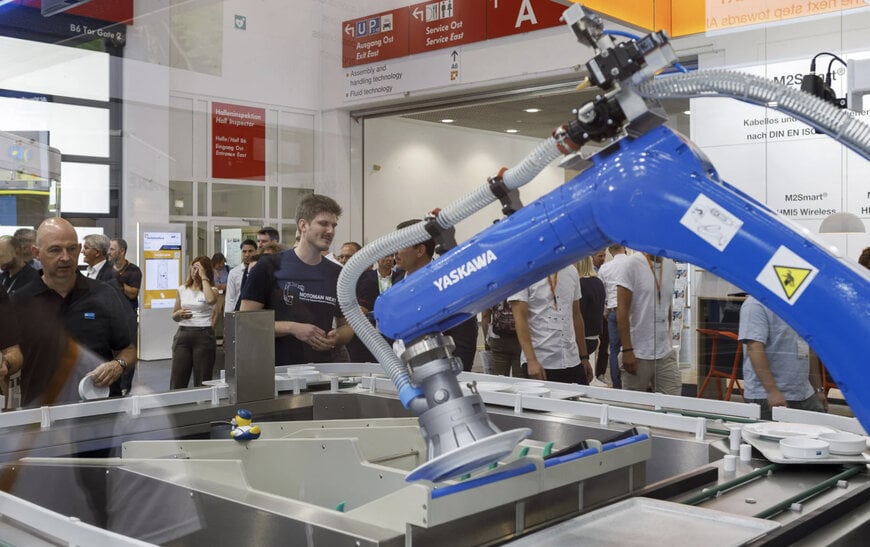
The integration of robots into industrial production environments continues to require extensive engineering by system integrators. At the same time, there is increasing demand to simplify programming, commissioning, and operation through new technologies. With the MOTOMAN NEXT platform, Yaskawa addresses these requirements by combining traditional automation logic with AI-driven adaptive robotics in a unified architecture.
Simplified programming and PLC integration
In many applications, robotic processes still rely on defined and repeatable workflows. Yaskawa focuses on simplified programming approaches that enable parameterization instead of conventional coding. User interfaces such as the Smart Pendant with SmartFrame technology, along with application-specific software tools, support faster commissioning.
A key extension is the direct integration into PLC programming environments. Through solutions such as MotoLogix, robot functions can be programmed and controlled using function blocks in accordance with IEC 61131-3. This allows the use of existing PLC expertise and reduces the need for specialized robot programmers. Supported platforms include Siemens, Beckhoff, B&R, Rockwell, and Codesys.
Adaptive robotics through AI and sensor integration
The integration of machine vision, sensors, and AI expands robotic capabilities toward adaptive applications. Robots can respond dynamically to variations in components or environmental conditions without requiring all workflows to be pre-programmed.
This enables the automation of processes involving high variability or small batch sizes, which were previously difficult to implement due to programming complexity. Tasks requiring visual recognition and flexible handling particularly benefit from this approach.
Platform architecture for IT and OT convergence
The MOTOMAN NEXT platform combines traditional operational technology (OT) control logic with IT-based development environments. In addition to supporting standard automation components such as PLCs, fieldbus systems, and safety functions, the platform integrates IT technologies including Linux-based systems, containerization, and data-driven applications.
An integrated CPU/GPU architecture based on NVIDIA technology provides the computing power required for AI applications. This allows machine vision, neural networks, and data processing to run directly on the robot controller without the need for external hardware.
Reduced engineering effort through integrated services
The platform includes preconfigured services that automate typical engineering tasks. These include collision-free path planning and configurable 2D/3D machine vision systems.
This integration reduces programming and commissioning effort while maintaining flexibility in application design. It supports system integrators in implementing complex projects under industrial and economic constraints.
Simulation and digital twin capabilities
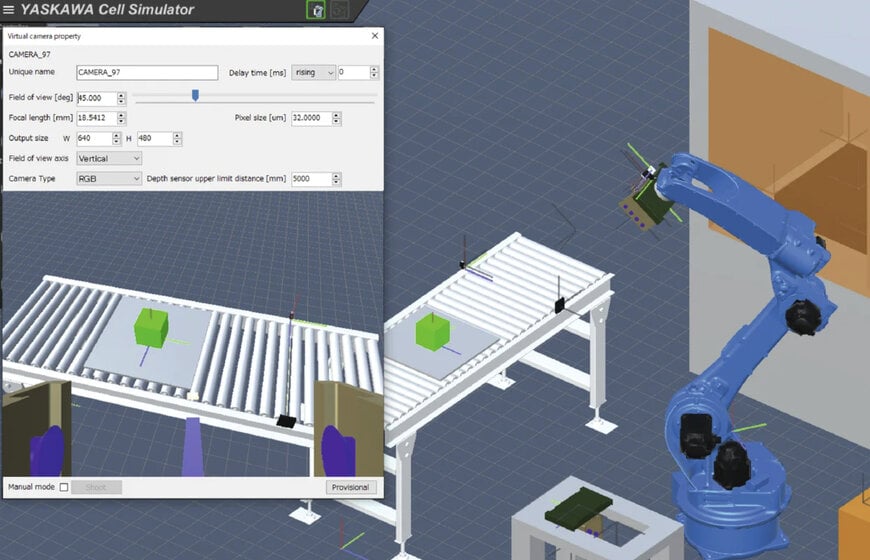
Simulation and engineering tools play a key role in planning and optimizing robotic systems. With extended capabilities available in tools such as the YNX Robot Simulator, adaptive robotics functions can be modeled in virtual environments.
The platform also supports development environments such as NVIDIA Isaac Sim and Sim2Real, enabling robots and AI models to be developed, trained, and tested in virtual scenarios. This reduces risk and development time prior to deployment.
From proof of concept to industrial deployment
The platform is designed to support both rapid prototyping and scalable industrial applications. While IT-driven approaches often focus on fast iteration, integration into an industrial control platform enables reliable transition to production environments.
Implications for system integrators
As IT and OT continue to converge, the role of system integrators is evolving. In addition to traditional automation expertise, knowledge of data-driven technologies and AI is becoming increasingly important.
By combining simplified programming, integrated AI functionality, and reduced system complexity, the platform provides a foundation for more efficient engineering processes and the expansion of robotics applications in industrial environments.
Edited by Maria Brueva, Induportals editor – adapted by AI.
www.yaskawa.com
