
www.ptreview.co.uk
17
'26
Written on Modified on
Schneider Electric and Microsoft Advance Agentic Manufacturing at Hannover Messe 2026
From April 20-25, in Hannover, discover how this strategic partnership leverages EcoStruxure and Azure AI to collapse traditional automation silos, enabling manufacturers to accelerate engineering and achieve sustainable, software-defined operations.
www.se.com
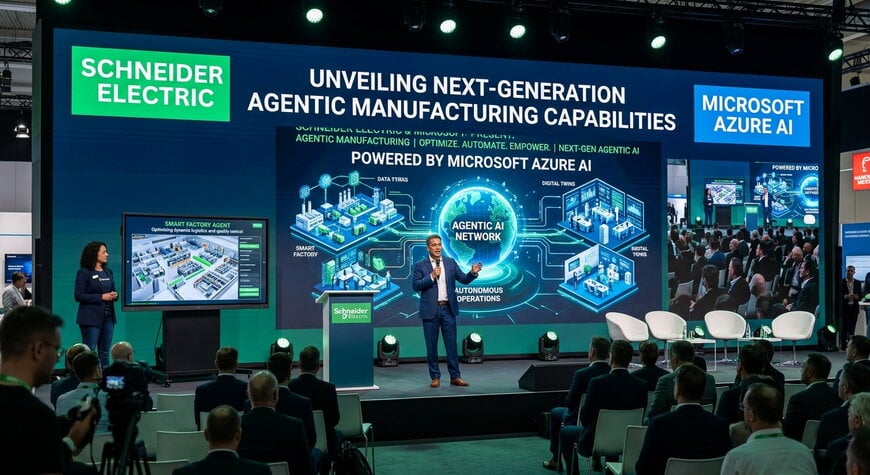
The strategic collaboration between Schneider Electric and Microsoft is redefining industrial efficiency by replacing rigid, fragmented systems with a unified, software-defined architecture. While traditional competitors often rely on proprietary ecosystems that require manual handoffs between engineering, simulation, and operations, the Schneider-Microsoft integration creates a single, interoperable workflow. This approach differentiates itself by leveraging open automation and AI-driven orchestration to ensure that logic authored once can be deployed anywhere — on-premises, at the edge, or in the cloud — without the typical burdens of hardware-specific retooling.
Converging Engineering Intent with Operational Execution
Modern manufacturing is frequently hindered by the disconnect between design software and factory-floor execution. Schneider Electric addresses this by utilizing EcoStruxure Automation Expert as a software-defined backbone, allowing teams to standardize reusable logic and validate it through digital twins before physical implementation. This system maintains end-to-end traceability across the entire lifecycle, a significant departure from standard industry practices where separate tools are required for every phase. By connecting Microsoft Azure’s AI and cloud services directly to the industrial execution layer, the partnership enables "agentic manufacturing," where AI agents automate routine design decisions and validate automation packages autonomously.
Real-World Gains in Efficiency and Cost Reduction
The impact of this integrated workflow is most evident in the significant reduction of lead times and operational costs. For instance, engineering teams using the Azure-powered industrial copilot have achieved a 50% time reduction in control configuration and documentation tasks. This technology transforms production line adjustments from week-long projects into tasks completed in mere hours. These efficiencies extend into highly demanding sectors, such as green hydrogen production. A collaboration with H2E Power demonstrated over 6,000 hours of stable autonomous operation in high-temperature electrolysis, ultimately lowering the levelized cost of hydrogen by up to 10% and saving approximately €500,000 annually for a 10 MW plant.
Scaling Resiliency through Interoperable Workflows
By collapsing the barriers between design, commissioning, and operations, Schneider Electric and Microsoft provide a scalable solution for manufacturers facing global supply chain instability and high product variability. The platform ensures that safety and compliance are embedded into the digital workflow, allowing highly regulated industries to modernize without compromising reliability. This transition from traditional, hardware-centric automation to a flexible, agentic model allows manufacturers to achieve a level of agility and sustainability that was previously unattainable under the constraints of legacy industrial frameworks.
Edited by Evgeny Churilov, Induportals Media - Adapted by AI.
www.se.com
