
www.ptreview.co.uk
26
'26
Written on Modified on
Linear robot axis extends reach in automation cells
Igus introduces a linear motion axis designed to simplify robot integration and increase working range in CNC handling and flexible manufacturing setups.
www.igus.eu
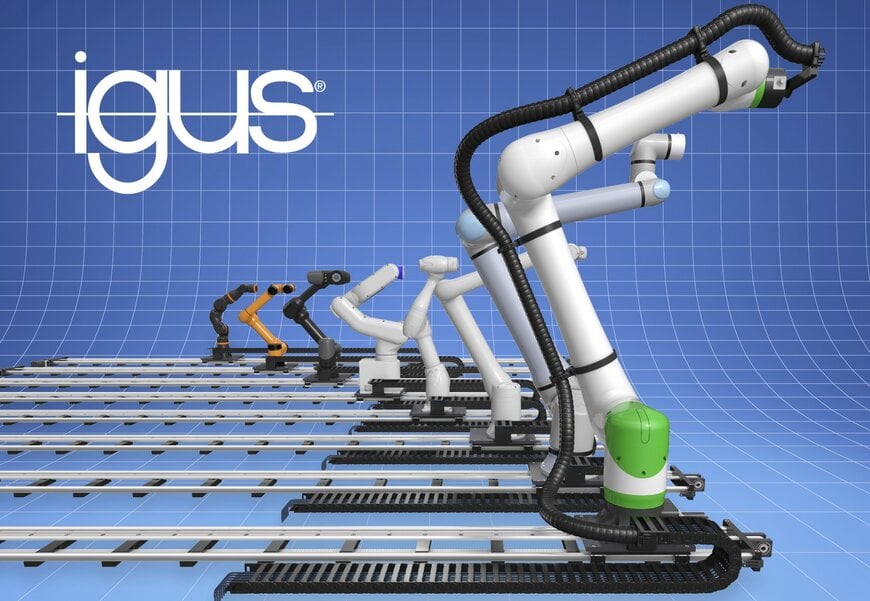
Extending the working envelope of industrial robots is a common requirement in flexible manufacturing and machine tending applications. In this context, igus introduced an updated seventh-axis linear system designed to expand robot workspaces and simplify integration into existing automation environments.
Extending robot reach in machine tending applications
The seventh axis enables articulated robots to move along a linear track, allowing a single robot to serve multiple workstations such as CNC machines or assembly stations. This approach is commonly used in factory automation where increasing robot utilisation can reduce the need for additional robotic systems.
The igus linear axis is designed for robots weighing up to 55 kg and can increase the working range by up to four times. The system is based on an aluminium linear profile with lengths of up to 6,000 mm. A carriage system mounted on lubrication-free polymer plain bearings enables movement along the axis.
The carriage is driven by an electric motor with a toothed belt mechanism and can reach speeds of up to 0.6 m/s with positioning accuracy specified at ±0.3 mm. Adapter kits allow robots to be mounted directly onto the carriage.
To manage moving cables, the system integrates igus e-chains® cable carriers designed to protect power and data connections. This type of cable management is relevant in robotic systems, where cable failures can affect operational reliability.
Integration into robot control environments
A key design objective of the system is reducing integration effort between the linear axis and robot control systems. The axis can be connected to robot controllers through preconfigured software interfaces, allowing automatic recognition after installation.
Compatibility has been extended to include Universal Robots UR20 and UR30 models as well as the FANUC CRX series. The system also supports integration with controllers from Epson, Dobot, igus, and Omron.
After installation, users can configure and operate the axis through the robot’s existing control interface. Control options include digital I/O interfaces, URCap environments, and igus Robot Control software.
Configuration and deployment considerations
The system includes safety-related elements such as emergency stop integration as part of the standard design, reducing additional engineering requirements during system integration.
An online configuration tool allows users to select robot type, mounting configuration, required axis length, and operating speed to generate application-specific configurations. Such tools are increasingly used in robot integration workflows to simplify specification and cost estimation during automation project planning.
The seventh-axis solution has already been deployed in more than 500 installations and reflects broader trends toward modular automation components intended to simplify robot deployment in dynamic production environments.
Edited by industrial journalist Aishwarya Mambet, with AI-assistance.
www.igus.com
