
www.ptreview.co.uk
25
'26
Written on Modified on
Cleanfix Integrates Sonair 3D Ultrasonic Sensor in Cleaning Robot
ADAR sensor replaces multi-sensor setups to enable reliable navigation and obstacle detection in dynamic, human-populated environments.
www.sonair.com
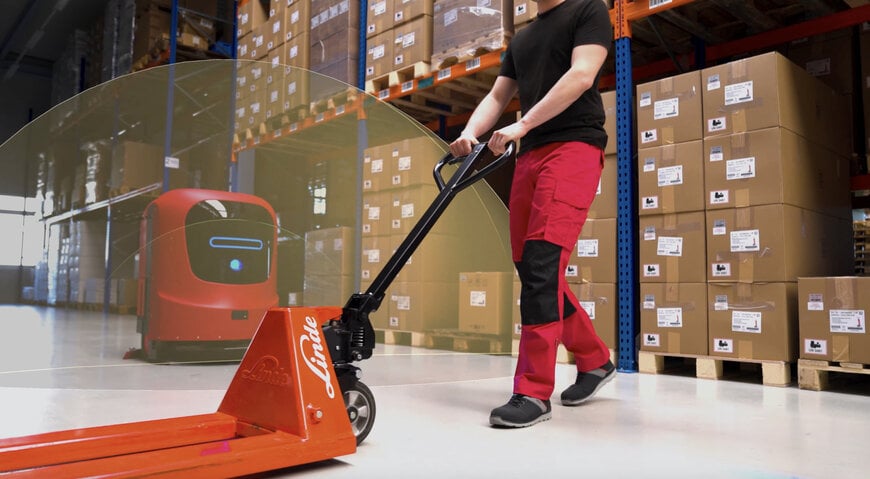
Autonomous cleaning in environments such as hospitals, schools, warehouses, and commercial facilities requires reliable obstacle detection and uninterrupted operation, and Cleanfix’s RA660 Navi XL integrates Sonair’s ADAR 3D ultrasonic sensor to improve navigation in shared human spaces.
Autonomous mobile robots operating in public or semi-public environments must handle unpredictable movement, variable lighting conditions, and diverse obstacles. In response, Cleanfix has introduced a new generation of its RA660 Navi XL cleaning robot, equipped with Sonair’s ADAR sensor, which provides three-dimensional spatial awareness using ultrasonic sensing rather than optical methods.
3D Ultrasonic Sensing for Reliable Environmental Perception
The ADAR sensor delivers a 180 × 180-degree field of view, generating real-time spatial data that supports navigation and motion control. Unlike camera- or LiDAR-based systems, ultrasonic sensing is less affected by lighting conditions, reflections, or airborne particles, enabling consistent performance in both illuminated and dark environments.
This capability allows the robot to detect small or partially obscured obstacles near the ground—such as tools, bags, or pallet edges—that can be difficult for traditional optical sensors to identify. As a result, the system improves navigation accuracy in cluttered, real-world settings.
Consolidation of Sensor Architecture
In earlier robot generations, multiple linear sensors were required to achieve sufficient coverage. With ADAR, Cleanfix replaces up to 14 individual sensors with a single unit, simplifying hardware architecture and reducing system complexity.
This consolidation also contributes to a more streamlined physical design, reducing potential points of failure and easing integration into the robot platform. Fewer components can translate into lower maintenance requirements and improved long-term reliability.
Reduced Downtime and Stable Operation
The use of ultrasonic sensing eliminates reliance on optical lenses, removing the need for regular cleaning caused by dust or debris accumulation. This low-maintenance approach supports higher system uptime, which is critical in commercial cleaning operations where robots are expected to operate for extended periods.
Additionally, the ADAR sensor reduces false-positive detections often associated with dust or airborne particles in optical systems. This minimizes unnecessary stops, allowing the robot to maintain consistent movement and improve area coverage over time.
Privacy and Deployment Flexibility
Because the ADAR sensor does not capture or store visual image data, the RA660 Navi XL can be deployed in privacy-sensitive environments such as healthcare facilities, schools, and public buildings. This characteristic supports compliance with data protection requirements while maintaining operational capability.
The system’s independence from ambient light conditions also enables reliable night-time operation, allowing cleaning tasks to be scheduled outside of active working hours without performance degradation.
Toward Safety-Certified Ultrasonic Robotics
Sonair is progressing toward safety certification of its 3D ultrasonic sensing technology according to PLd ISO 13849 and SIL IEC 61508 standards. If achieved, this would represent a significant step in enabling ultrasonic perception systems to meet functional safety requirements for collaborative and service robotics.
By integrating 3D ultrasonic sensing into its cleaning platform, Cleanfix demonstrates an alternative approach to robot perception that prioritizes robustness, reduced maintenance, and operational stability in dynamic, human-centric environments.
Edited by Natania Lyngdoh, Induportals Editor — Adapted by AI.
www.sonair.com
