
www.ptreview.co.uk
25
'26
Written on Modified on
Digital Twin Enables Real-Time CNC Error Correction
Mitsubishi Electric and RWTH Aachen University develop digital twin technology for machine tools, reducing machining errors and improving production efficiency.
www.mitsubishielectric.com
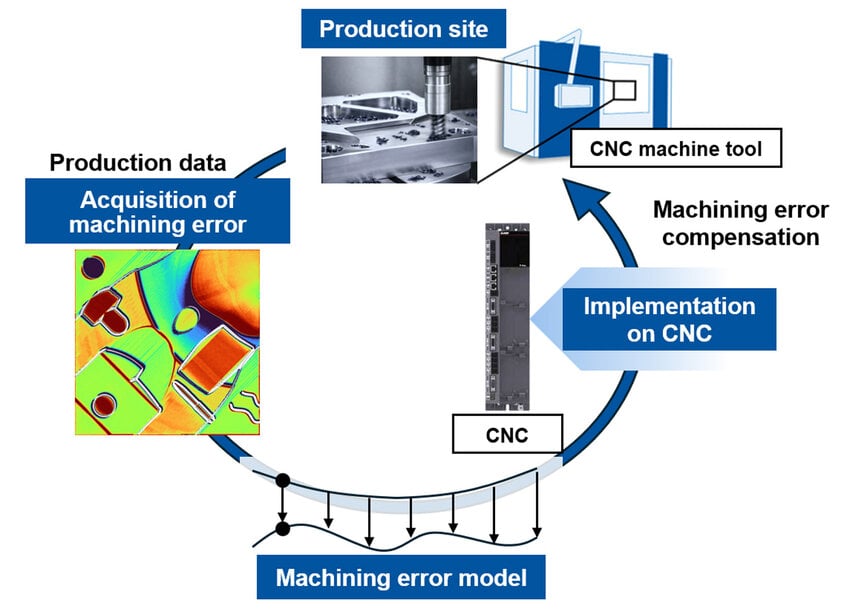
Mitsubishi Electric, in collaboration with RWTH Aachen University, has developed a digital twin-based technology that corrects machining errors in real time on CNC machine tools. The system reduces deformation-related errors during cutting processes by up to 50%, improving part quality and production efficiency.
Real-Time Error Compensation in CNC Machining
In high-precision manufacturing, machining errors can occur when cutting forces deform the workpiece. These deviations affect dimensional accuracy and surface quality, leading to rejected parts and increased material waste.
The developed digital twin technology continuously estimates such errors during operation and feeds corrective adjustments back into the CNC control system. This enables dynamic compensation without interrupting the machining process.
Compact Physical Model with High-Speed Data Processing
The system is based on a digital twin model designed for real-time execution using edge computing. The model incorporates key process variables such as axis positions, motor currents, and cutting forces, which are captured at high sampling rates.
A compact physical model—constructed from a minimal set of equations—processes this data to estimate deformation effects. By focusing only on relevant parameters, the system maintains high computational efficiency while delivering accurate predictions.
Integration into CNC Control Systems
The digital twin operates directly within the control loop of CNC machines, enabling immediate correction of detected deviations. This integration ensures that adjustments are applied during machining, rather than after inspection.
Real-time feedback improves machining stability, particularly in operations involving complex geometries or variable cutting conditions.
Impact on Productivity and Quality
Testing demonstrated that the system can reduce machining errors caused by tool-induced deformation by up to 50%. This leads to fewer defective parts, improved dimensional accuracy, and more consistent surface finishes.
By reducing scrap and rework, the technology contributes to higher production efficiency and lower material consumption.
Development and Research Context
The technology was developed between April 2023 and March 2026 as part of a joint research initiative focused on digital twin applications and edge computing in manufacturing. RWTH Aachen University contributed expertise in digital modelling, while Mitsubishi Electric focused on CNC system integration.
Relevance for Digital Manufacturing
The integration of digital twin technology into machine tools reflects a broader shift toward data-driven, adaptive manufacturing systems. Real-time process monitoring and correction enable more precise control over production outcomes.
Within a digital supply chain, such systems support improved traceability, reduced variability, and more efficient resource use, aligning manufacturing performance with sustainability and quality objectives.
Edited by Romila DSilva, Induportals Editor, with AI assistance.
www.mitsubishielectric.com
