
www.ptreview.co.uk
17
'26
Written on Modified on
STMicroelectronics Integrates Robotics Hardware with NVIDIA AI Platforms
The collaboration combines sensors, microcontrollers, and simulation models to streamline development, training, and deployment of humanoid and industrial robotics systems.
www.st.com
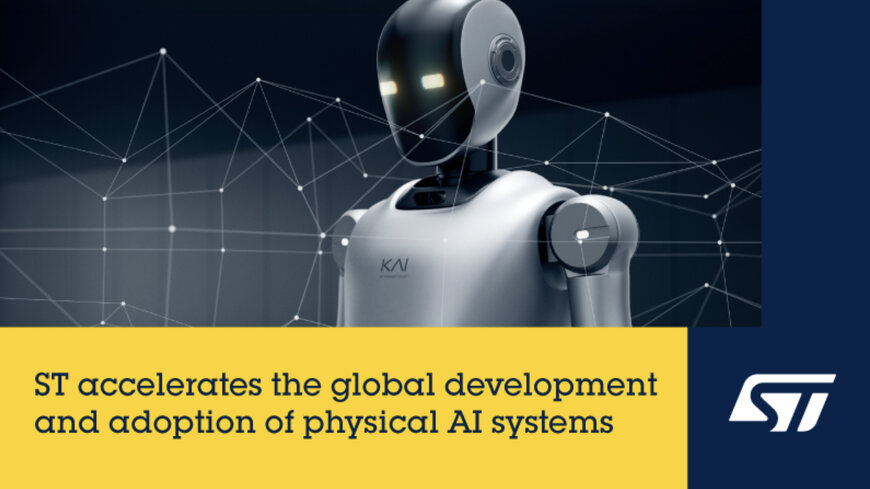
Humanoid robots, industrial automation systems, and service robotics increasingly depend on tightly integrated sensing, control, and simulation environments to accelerate development and deployment. In this context, STMicroelectronics is expanding its collaboration with NVIDIA to integrate its sensors, microcontrollers, and motor control solutions into NVIDIA’s robotics ecosystem, targeting faster and more scalable development of physical AI systems.
The initiative focuses on bridging simulation and real-world deployment, enabling developers to design, train, and implement robotics systems with improved efficiency and reliability.
Integration with NVIDIA Holoscan Sensor Bridge
A key element of this collaboration is the integration of ST components with the NVIDIA Holoscan Sensor Bridge (HSB), which standardizes how sensor and actuator data is acquired, synchronized, and processed.
This integration enables developers to:
- Connect multiple sensors and actuators through a unified interface
- Streamline data acquisition and logging workflows
- Build consistent datasets for AI model training
The approach is particularly relevant for robotics systems requiring synchronized inputs from multiple sensing modalities, such as inertial measurement units (IMUs), imaging sensors, and time-of-flight (ToF) devices.
An early implementation includes a stereo depth camera developed by Leopard Imaging using ST sensing technologies, designed for robotics applications requiring spatial awareness and depth perception.
Supporting sim-to-real workflows with high-fidelity models
Another core component of the collaboration is the integration of high-fidelity digital models of ST components into NVIDIA Isaac Sim, part of the Omniverse-based simulation environment.
The first available model is an IMU, with additional models for ToF sensors, actuators, and other integrated circuits under development. These models are derived from real hardware measurements, enabling simulations that closely replicate actual device behavior.
This approach addresses key challenges in robotics development:
An early implementation includes a stereo depth camera developed by Leopard Imaging using ST sensing technologies, designed for robotics applications requiring spatial awareness and depth perception.
Supporting sim-to-real workflows with high-fidelity models
Another core component of the collaboration is the integration of high-fidelity digital models of ST components into NVIDIA Isaac Sim, part of the Omniverse-based simulation environment.
The first available model is an IMU, with additional models for ToF sensors, actuators, and other integrated circuits under development. These models are derived from real hardware measurements, enabling simulations that closely replicate actual device behavior.
This approach addresses key challenges in robotics development:
- Reducing discrepancies between simulated and real-world performance
- Improving convergence of AI training models
- Minimizing inefficient or unrealistic parameter randomization
By improving simulation accuracy, developers can shorten development cycles and reduce the cost of prototyping and testing.
Simplifying hardware-software co-design
The collaboration also focuses on simplifying integration between hardware and AI platforms. Pre-integrated solutions combining STM32 microcontrollers, sensors, and motor control systems are being aligned with NVIDIA Jetson platforms.
This enables a more cohesive development workflow, where:
Simplifying hardware-software co-design
The collaboration also focuses on simplifying integration between hardware and AI platforms. Pre-integrated solutions combining STM32 microcontrollers, sensors, and motor control systems are being aligned with NVIDIA Jetson platforms.
This enables a more cohesive development workflow, where:
- AI models can be trained in simulation
- Sensor and actuator behavior is accurately represented
- Deployment to physical systems requires fewer adjustments
Such integration is particularly relevant for humanoid robots and complex autonomous systems, where coordination between perception, motion, and control is critical.
Addressing complexity and scalability in robotics
Developing advanced robotics systems typically involves high computational demands, large datasets, and significant engineering effort to tune simulation parameters. Inaccurate modeling or excessive variability can lead to inefficient training and reduced real-world performance.
By providing hardware-calibrated models and standardized integration pathways, STMicroelectronics and NVIDIA aim to reduce these challenges, enabling more scalable development of physical AI systems.
Positioning in the robotics ecosystem
The collaboration reflects a broader industry trend toward tighter coupling between semiconductor technologies and AI development platforms. By aligning sensing, processing, and simulation tools, companies are working to reduce fragmentation in robotics system design.
STMicroelectronics’ contribution lies in combining its portfolio of sensors, microcontrollers, and motor control technologies with NVIDIA’s AI and simulation infrastructure, creating a unified development environment for next-generation robotics applications.
Edited by Industrial Journalist, Natania Lyngdoh — AI-Powered.
www.st.com
Addressing complexity and scalability in robotics
Developing advanced robotics systems typically involves high computational demands, large datasets, and significant engineering effort to tune simulation parameters. Inaccurate modeling or excessive variability can lead to inefficient training and reduced real-world performance.
By providing hardware-calibrated models and standardized integration pathways, STMicroelectronics and NVIDIA aim to reduce these challenges, enabling more scalable development of physical AI systems.
Positioning in the robotics ecosystem
The collaboration reflects a broader industry trend toward tighter coupling between semiconductor technologies and AI development platforms. By aligning sensing, processing, and simulation tools, companies are working to reduce fragmentation in robotics system design.
STMicroelectronics’ contribution lies in combining its portfolio of sensors, microcontrollers, and motor control technologies with NVIDIA’s AI and simulation infrastructure, creating a unified development environment for next-generation robotics applications.
Edited by Industrial Journalist, Natania Lyngdoh — AI-Powered.
www.st.com
