
www.ptreview.co.uk
13
'26
Written on Modified on
Engineering training improves industrial steam system performance
Bürkert highlights how technical training supports safer steam system design, energy efficiency, and process optimisation across food processing and pharmaceutical production.
www.buerkert.de
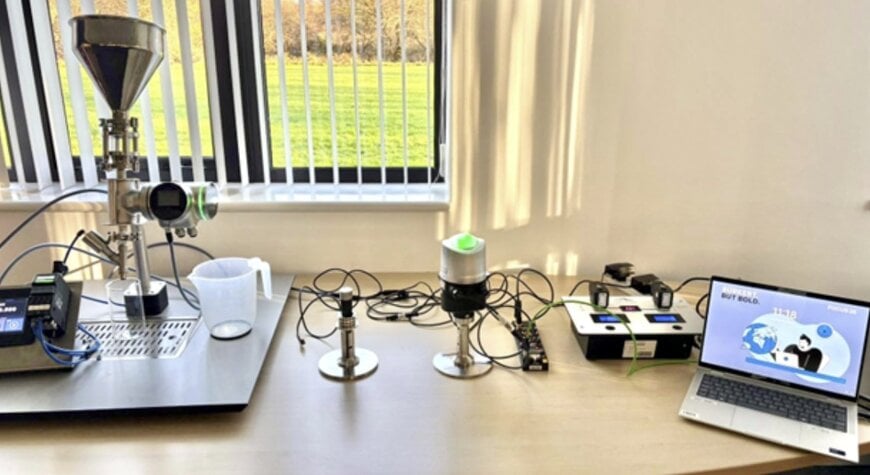
Steam remains a key thermal energy carrier in industries requiring controlled heat transfer, sterilisation, and drying processes. In this context, Kieran Bennett, Technical Sales Engineer & Trainer at flow control specialist Bürkert, emphasised the role of specialist engineering training to improve steam system design, operation, and maintenance practices.
Steam remains central to thermal processes across industries
Steam continues to play an important role in sectors such as food processing, pharmaceuticals, electronics manufacturing, and power generation, where controlled heat transfer and hygiene are critical process requirements.
In food production, steam supports controlled industrial cooking as well as temperature regulation in brewing and distilling processes. In pharmaceutical production, it is used for sterilisation-in-place (SIP) processes where hygiene requirements demand validated cleaning procedures. Electronics manufacturing uses steam drying because the latent heat released during condensation accelerates moisture evaporation from components and assemblies.
At a larger scale, thermal power plants use steam to drive turbines for electricity generation, illustrating its continued role in industrial energy systems.
Understanding steam behaviour in process engineering
Engineering challenges often arise when steam is treated as a conventional gas rather than as a phase-change medium. In thermodynamic terms, saturated steam exists at the temperature corresponding to its pressure and remains in equilibrium with liquid water, while superheated steam exists above this temperature and contains no liquid phase.
Steam transfers energy primarily through condensation rather than simple mass flow. This mechanism requires valve sizing and flow control calculations to consider phase transition, volumetric expansion, and choking effects. If these parameters are not considered, control instability, efficiency losses, and compliance risks can result.
Incorrect specification frequently results in oversized valves, which can create unstable flow conditions, excessive noise, and pressure drops that limit temperature control accuracy. Such issues may be misinterpreted as component failures rather than specification errors.
Specification errors affecting efficiency, maintenance, and safety
Oversized steam valves can increase energy consumption by allowing excess steam flow, while also increasing wear on valve seats and raising maintenance requirements. Undersized components may expose systems to thermal stress due to insufficient capacity.
Steam applications also require stricter safety procedures than most liquid or gas systems due to stored thermal energy and pressure risks. Maintenance procedures commonly require two independent lockable isolation points between live steam systems and serviced equipment, compared to single isolation points typically accepted for other media.
These engineering requirements highlight the importance of specialist knowledge in steam system design and operation, particularly as steam infrastructure often receives less attention than production equipment despite its importance to overall process reliability.
Training programmes addressing knowledge gaps in steam engineering
At JBT Marel’s facility in Livingston, West Lothian, steam is used in multiple food technology processes, including cooking and freezing system operations. To address varying experience levels within its engineering team, JBT Marel commissioned Bürkert to provide training in steam system design and management.
The two-day training programme covered steam properties, use of steam tables, and calculation methods, alongside practical design considerations for improving performance, efficiency, and safety compliance. The course also addressed isolation procedures and other operational safety requirements.
Following the training, engineering teams were able to better assess steam distribution lines and equipment performance, support predictive maintenance strategies, and improve troubleshooting capabilities. The programme also supported the development of application-specific solutions aligned with customer requirements.
Such training approaches reflect the continued importance of practical engineering knowledge in maintaining industrial utilities that function as essential but often overlooked infrastructure within modern production environments.
www.burkert.com
Edited by industrial journalist, Aishwarya Mambet — AI-powered.
