
www.ptreview.co.uk
27
'26
Written on Modified on
Natural Language Control Reaches Industrial Motion Systems
Beckhoff demonstrates how language models interact with deterministic control platforms to execute coordinated robot motion and diagnostics in manufacturing environments.
www.beckhoff.com
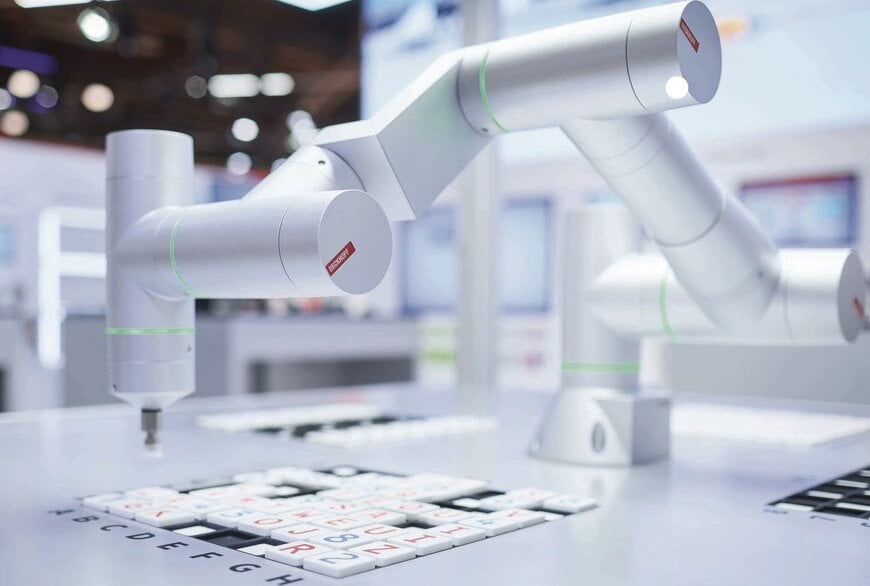
Picture credits: Beckhoff Automation
Industrial control systems traditionally rely on predefined logic and engineering tools. A different approach links large language models to real-time automation platforms so machines can interpret operator intent instead of fixed commands. At Hannover Messe 2026 (April 20–24, Hanover, Germany), Beckhoff is presenting a physical-AI control architecture that connects LLM reasoning directly to motion control hardware.
From PLC logic to contextual machine behavior
Conventional automation separates IT-level intelligence from OT-level deterministic control. Programmable logic controllers execute validated sequences, while optimization and analytics typically operate externally. The architecture to be presented at the fair connects these layers through standardized interfaces, allowing an AI model to generate instructions that a real-time controller executes safely and deterministically.
This approach is relevant for manufacturing cells, robotics, assembly, and flexible material handling systems where frequent reconfiguration is required. Instead of editing control code, an operator specifies the task in natural language. The control system interprets intent, translates it into motion instructions, and executes them within industrial timing constraints.
The concept positions the language model as part of the operational layer of a digital supply chain rather than as an isolated analysis tool.
Voice commands triggering coordinated motion
At the Hannover Messe Press Preview on February 25, Beckhoff provided an initial insight using a compact demonstration cell. The setup combined the XPlanar planar motor transport system with the TwinCAT CoAgent AI runtime and an audio interface. Floating movers received motion instructions generated from spoken language and initiated the next movement sequence automatically. The controller converted semantic input into deterministic trajectories while maintaining control-cycle requirements.
The demonstration illustrated how language-based control could trigger coordinated multi-axis motion without manual programming, enabling non-specialists to operate complex automation sequences.
From demo cell to industrial robotics
At Hannover Messe 2026, the scenario expands to a fully integrated industrial application centered on the ATRO modular industrial robot system operated via TwinCAT CoAgent for Operations. The system uses the Model Context Protocol (MCP) to connect the language model to the machine control stack.
Within this architecture, the AI agent interprets spoken instructions, generates path planning parameters, and initiates diagnostic procedures. The exhibition scenario features the robot playing chess against visitors, demonstrating coordinated perception, decision-making, and motion execution in real time rather than recommendation-based assistance.
Engineering workflow and runtime diagnostics
Beckhoff integrates the concept into its automation ecosystem through TwinCAT CoAgent as the runtime interface between language models and control systems, and TwinCAT Machine Learning Creator for model generation and deployment. The tools support both engineering and operational phases, including automated configuration assistance and fault analysis during operation.
Rather than replacing PLC logic, the system adds a supervisory reasoning layer capable of generating structured instructions that remain consistent with deterministic control constraints.
Implications for automation architecture
The architecture embeds AI within the control framework rather than positioning it externally. The language model interprets context, while the deterministic controller enforces timing and safety boundaries. This separation maintains industrial reliability while enabling adaptive behavior.
In manufacturing environments where product variants and workflows change frequently, natural language interaction can reduce commissioning effort while standardized protocols such as MCP preserve compatibility with established automation practices across robotics and production systems.
www.beckhoff.com
Industrial control systems traditionally rely on predefined logic and engineering tools. A different approach links large language models to real-time automation platforms so machines can interpret operator intent instead of fixed commands. At Hannover Messe 2026 (April 20–24, Hanover, Germany), Beckhoff is presenting a physical-AI control architecture that connects LLM reasoning directly to motion control hardware.
From PLC logic to contextual machine behavior
Conventional automation separates IT-level intelligence from OT-level deterministic control. Programmable logic controllers execute validated sequences, while optimization and analytics typically operate externally. The architecture to be presented at the fair connects these layers through standardized interfaces, allowing an AI model to generate instructions that a real-time controller executes safely and deterministically.
This approach is relevant for manufacturing cells, robotics, assembly, and flexible material handling systems where frequent reconfiguration is required. Instead of editing control code, an operator specifies the task in natural language. The control system interprets intent, translates it into motion instructions, and executes them within industrial timing constraints.
The concept positions the language model as part of the operational layer of a digital supply chain rather than as an isolated analysis tool.
Voice commands triggering coordinated motion
At the Hannover Messe Press Preview on February 25, Beckhoff provided an initial insight using a compact demonstration cell. The setup combined the XPlanar planar motor transport system with the TwinCAT CoAgent AI runtime and an audio interface. Floating movers received motion instructions generated from spoken language and initiated the next movement sequence automatically. The controller converted semantic input into deterministic trajectories while maintaining control-cycle requirements.
The demonstration illustrated how language-based control could trigger coordinated multi-axis motion without manual programming, enabling non-specialists to operate complex automation sequences.
From demo cell to industrial robotics
At Hannover Messe 2026, the scenario expands to a fully integrated industrial application centered on the ATRO modular industrial robot system operated via TwinCAT CoAgent for Operations. The system uses the Model Context Protocol (MCP) to connect the language model to the machine control stack.
Within this architecture, the AI agent interprets spoken instructions, generates path planning parameters, and initiates diagnostic procedures. The exhibition scenario features the robot playing chess against visitors, demonstrating coordinated perception, decision-making, and motion execution in real time rather than recommendation-based assistance.
Engineering workflow and runtime diagnostics
Beckhoff integrates the concept into its automation ecosystem through TwinCAT CoAgent as the runtime interface between language models and control systems, and TwinCAT Machine Learning Creator for model generation and deployment. The tools support both engineering and operational phases, including automated configuration assistance and fault analysis during operation.
Rather than replacing PLC logic, the system adds a supervisory reasoning layer capable of generating structured instructions that remain consistent with deterministic control constraints.
Implications for automation architecture
The architecture embeds AI within the control framework rather than positioning it externally. The language model interprets context, while the deterministic controller enforces timing and safety boundaries. This separation maintains industrial reliability while enabling adaptive behavior.
In manufacturing environments where product variants and workflows change frequently, natural language interaction can reduce commissioning effort while standardized protocols such as MCP preserve compatibility with established automation practices across robotics and production systems.
www.beckhoff.com
