
www.ptreview.co.uk
03
'26
Written on Modified on
Modular Evolution of Distributed Control Systems
ABB has defined a structured framework to extend distributed control systems while preserving operational continuity across process industries.
global.abb

ABB has introduced Automation Extended, a program that enables industries to modernise distributed control systems progressively, maintaining deterministic control while integrating advanced digital capabilities.
Addressing modernisation constraints in process industries
Industrial operators are under pressure from market volatility, tighter regulatory requirements, increasing cyber security risks, and workforce transitions. Modernisation of control systems is often constrained by the need to avoid downtime, preserve validated configurations, and manage risk in safety-critical environments. Automation Extended is positioned to address these constraints by enabling incremental upgrades rather than large-scale system replacements.
The program builds on ABB’s established distributed control system (DCS) platforms, allowing existing installations to remain operational while new functionality is introduced in parallel. This approach is relevant for industries such as oil and gas, chemicals, power generation, and metals, where continuity of operations is a core requirement within the digital supply chain.
Progressive integration on existing control platforms
Operators can continue to run established ABB control systems, including ABB Ability System 800xA, ABB Ability Symphony Plus, and ABB Freelance, while introducing new automation and digital technologies in stages. This reduces migration risk and allows upgrades to be aligned with maintenance windows, production schedules, or regulatory milestones.
Rather than replacing control logic or hardware wholesale, the program focuses on extending system capabilities around the existing core. This preserves system integrity and operational knowledge while providing a controlled pathway to modern architectures.
Separation of control and digital environments
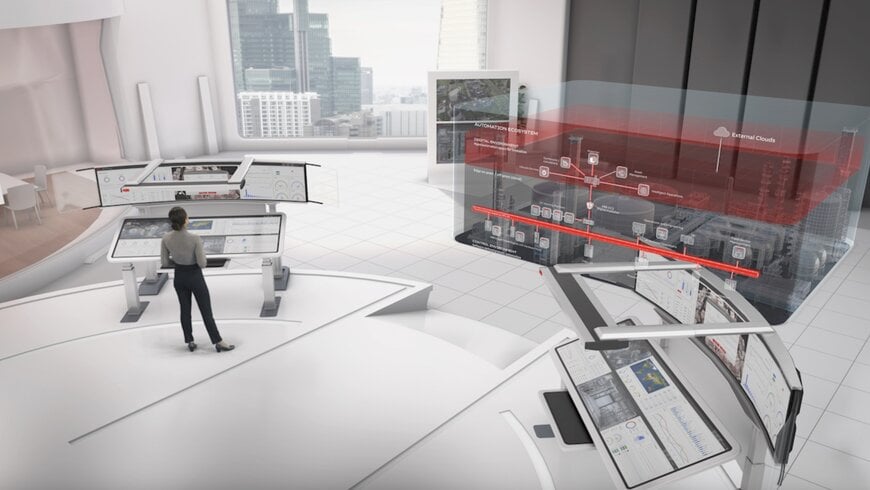
A central design principle of Automation Extended is separation of concerns between two securely interconnected environments. The control environment is software-defined and dedicated to deterministic, real-time control of critical processes. Its primary function is to ensure reliability, availability, and predictable response times.
The digital environment operates alongside the control layer and is designed for advanced applications, analytics, and data-driven optimisation. By decoupling these functions, operators can deploy artificial intelligence and machine learning–based tools for decision support without affecting validated control logic or process stability. Secure interfaces between the two environments allow data exchange while maintaining cyber security boundaries.
Open, modular architecture and interoperability
Automation Extended is based on an open and modular architecture to support interoperability across systems and domains. An Open Platform Communications Unified Architecture (OPC UA) backbone enables standardised data exchange between control systems, edge devices, and higher-level applications.
The use of cloud-native architectural principles—including containerisation, orchestration, and modular services—supports scalable deployment of applications across diverse hardware platforms. This allows engineering teams to develop, test, and deploy functionality more efficiently, while supporting reuse and standardisation across sites.
From a technical standpoint, this architecture supports a range of enhancements, such as real-time condition monitoring of critical assets, early detection of process anomalies, and optimisation of maintenance strategies through continuous data analysis.
Lifecycle services and operational implications
Automation Extended is supported by a unified automation service approach that spans lifecycle management of both control and digital environments. This includes maintenance, optimisation, and evolution of the automation ecosystem as technologies and operational requirements change.
Access to the Automation Extended framework will be enabled through upcoming releases of ABB’s major process automation systems. For operators, this provides a structured and lower-risk route to introduce advanced analytics, IoT integration, and modular engineering practices, while maintaining stable and deterministic process control in complex industrial environments.
new.abb.com
