
www.ptreview.co.uk
21
'26
Written on Modified on
CNC automation boosts machining efficiency and flexibility
Okuma Europe showcases automated CNC systems to enhance productivity, reduce manual intervention, and integrate smart data management at Open House 2026.
www.okuma.eu
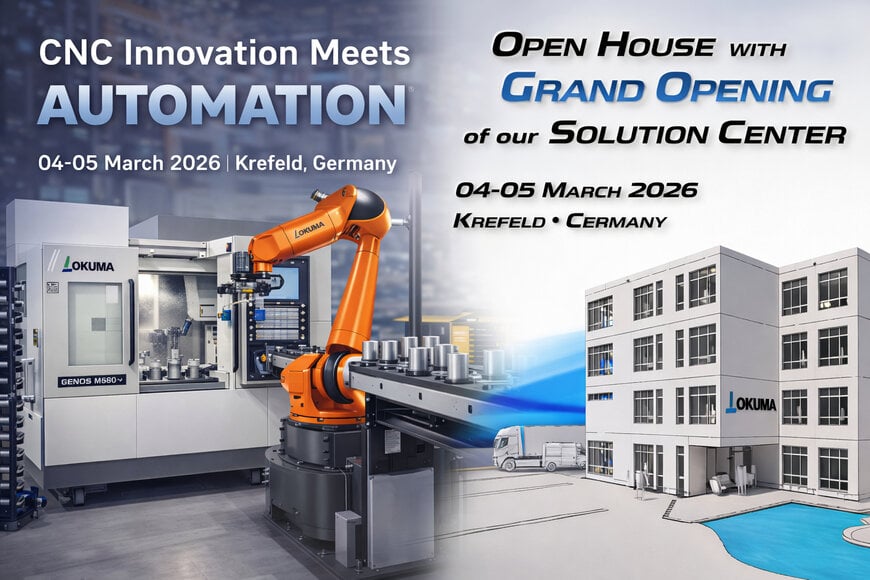
At the Open House 2026 event held on 4–5 March 2026 at Okuma Europe’s headquarters in Krefeld, Germany, Okuma Europe GmbH presented a suite of integrated CNC automation solutions designed to address key operational challenges encountered by modern manufacturers. The company, a subsidiary of the global machine tool builder Okuma Corporation, develops CNC machine tools and automation systems used across aerospace, automotive, toolmaking, and general metalworking industries.
Manufacturers increasingly face pressure to improve productivity, reduce manual handling, and maintain high precision while coping with workforce constraints and production complexity. Responding to these challenges requires solutions that extend autonomous operation, streamline process flow, and link data across machines for coordinated production scheduling and tooling management.
To meet these needs, Okuma Europe showcased automated manufacturing cells that combine machine tools with robotic and handling systems. The goal is to push beyond traditional single-process machining toward seamless, multi-machine production sequences that require minimal operator involvement yet maintain process stability, high utilisation rates and consistent quality outputs.
Technical Solution and Selection Rationale
The showcased solutions unite Okuma CNC machines with bespoke automation cells, including gantry loaders, robotic part handlers, pallet changers, and integrated smart data functions. Crucially, these systems are fully integrated with Okuma’s OSP control platform, providing unified operation across machine and automation components.
Manufacturers selected this integrated approach because it eliminates interface gaps between the machine and automation equipment and simplifies setup and changeover. In contrast to stand-alone retrofit automation, Okuma’s configuration supports extended unmanned runtime and improved process reliability. Integration into a single control system also enables coordinated tool and data management, reducing setup times and errors associated with manual data transfer.
Key automated configurations demonstrated include automated loading/unloading via Okuma Gantry Loader (OGL) paired with a twin-spindle lathe, and compact robot cells working with multitasking and 5-axis machining centres. These solutions aim to increase machine autonomy, allowing continuous operation with reduced operator presence while maintaining precision and throughput.
Deployment and Support
Okuma Europe’s deployment methodology centres on combining its own CNC machine expertise with automation partners to create complete solutions tailored to specific production needs. At Open House 2026, the unveiling of a new Solution Center at the Krefeld headquarters signified a dedicated environment where customers can collaborate with Okuma engineers to define automation strategies, simulate workflows, and assess performance outcomes before installation.
The Solution Center also demonstrates integrated tool data management across multiple machines via the “SMART FACTORY” function, where tool information is centrally stored and updated in real time. This reduces inconsistencies, minimizes manual programming errors, and enhances scheduling accuracy across automated cells.
Results and Benefits
While specific efficiency improvements were not published in numeric terms in the announcement, the technical deployment yields measurable operational gains:
- Extended Autonomous Operation: Automated material handling and pallet storage enable machines to operate with minimal human intervention, increasing available machining hours per shift and reducing idle time between jobs.
- Reduced Manual Setup: Robots and gantry systems handle part loading and unloading, lowering the risk of human error and allowing skilled staff to focus on high-value tasks.
- Consistent Data Management: Centralised tool and program data reduces setup errors and accelerates changeover between production runs, enhancing flexibility in mixed manufacturing environments.
- Process Stability and Precision: Integrated automation reduces variability associated with manual handling and supports stable, repeatable operations in high-precision machining applications.
Together, these improvements align with industry priorities such as higher productivity, optimized workforce deployment, and scalable automated manufacturing—benefits that are particularly relevant in sectors where precision and uptime directly influence competitiveness.
www.okuma.eu
www.okuma.eu
