
www.ptreview.co.uk
15
'26
Written on Modified on
Simple Robot Soldering Through EMI Teach-In Mode
Eutect expands its robot automation platform with an intuitive teach-in interface to simplify collaborative robot soldering workflows.
eutect.de
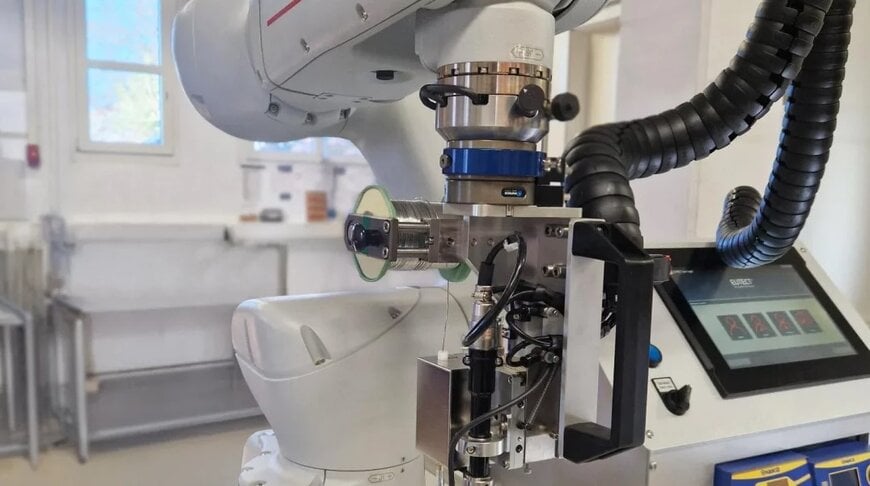
The EMI teach-in mode introduced by Eutect GmbH enables collaborative robot soldering to be programmed without traditional coding, addressing flexibility and efficiency needs in electronics manufacturing. This technology targets applications such as high-mix/low-volume production and prototype assembly by reducing set-up times and enabling precise movement sequence definition for soldering tasks.
Intuitive Teach-In for Collaborative Robot Soldering
Eutect’s EMI (EUTECT Machine Interface) teach-in mode augments its Multiple Process Changer (MPC) automation platform by enabling operators to record robot motion and soldering parameters directly on the workpiece. Instead of writing robot code or using external programming tools, technicians manually guide a collaborative robot to positions on the printed circuit board (PCB), with these coordinates captured and stored in EMI’s control software. This approach embeds movement sequences, dwell times, and soldering points into a reproducible job without requiring specialized robotics programming expertise.
Centralized coordination of all robot axes and ancillary movements through EMI ensures that motion paths and process parameters remain consistent across production runs. Operators can graphically edit and optimize sequences using tools such as the DAT editor and JobCreator within EMI, which support definition of X, Y, Z positions, rotary and feed axes, and associated speeds and timings.
Relevance to Electronics Production and Digital Supply Chain Workflows
The adoption of teach-in mode responds to a growing demand within electronics manufacturing for automated soldering that supports rapid variant changes and reduces engineering overhead. Traditional robot programming typically requires specialized skills and longer commissioning periods; teach-in reduces these barriers by capturing real movement paths directly during setup. This capability aligns with broader digital supply chain objectives by enabling more agile automation deployment and faster adaptation of production lines to new products without extensive reprogramming.
Eutect demonstrated this solution at productronica 2025 (Munich, November 2025), integrating MPC with a Mitsubishi MELFA ASSISTA collaborative robot and piston soldering head. The system combines robot, control, and soldering head into a single automation unit and can be adapted with different soldering tools to meet varied assembly requirements.
Technical Benefits and Use Cases
Teach-in mode delivers measurable operational improvements by significantly shortening commissioning and job setup periods, lowering training and engineering costs, and improving flexibility for frequent product changes. By avoiding conventional programming, manufacturers can implement new soldering jobs directly on the line, reducing dependency on robotics specialists. Consistent reproduction of soldering paths and parameters also supports quality control in repetitive tasks.
Example use cases include prototype production environments where design iterations require rapid reconfiguration, and high-mix/low-volume production lines where traditional programming costs could outweigh the benefits of automation. The system’s ability to integrate with various robot solutions further broadens applicability beyond a single vendor ecosystem.
Positioning and Integration
Eutect has been integrating collaborative robotics into its soldering cells since 2018, and the development of EMI teach-in mode draws on this experience to enhance human–robot interaction in soldering workflows. The MPC platform positions Eutect’s automation offering as a flexible solution capable of supporting different soldering processes and tools, fitting into existing electronics manufacturing architectures and facilitating future extensions without code-intensive re-engineering.
www.eutect.de
