
www.ptreview.co.uk
07
'26
Written on Modified on
AI-Driven Automotive Engineering Platforms
How Synopsys applies virtualization and simulation to support software-defined vehicle development and system-level validation across the automotive data ecosystem.
www.synopsys.com
At CES 2026, January 6-9, in Las Vegas, Synopsys presented a portfolio of AI-enabled simulation and virtualization technologies designed to reduce development time and cost in software-defined automotive engineering. The approach targets OEMs, Tier 1 suppliers, and semiconductor vendors developing complex electronics platforms for advanced driver assistance, electrification, and connected mobility.
Engineering Context and Technical Relevance
Automotive product development is increasingly constrained by software complexity, heterogeneous compute architectures, and long hardware validation cycles. As vehicles transition toward software-defined platforms, traditional prototype-heavy workflows scale poorly. According to Synopsys, physical testing and late-stage integration can account for hundreds of millions of dollars annually for large vehicle programs.
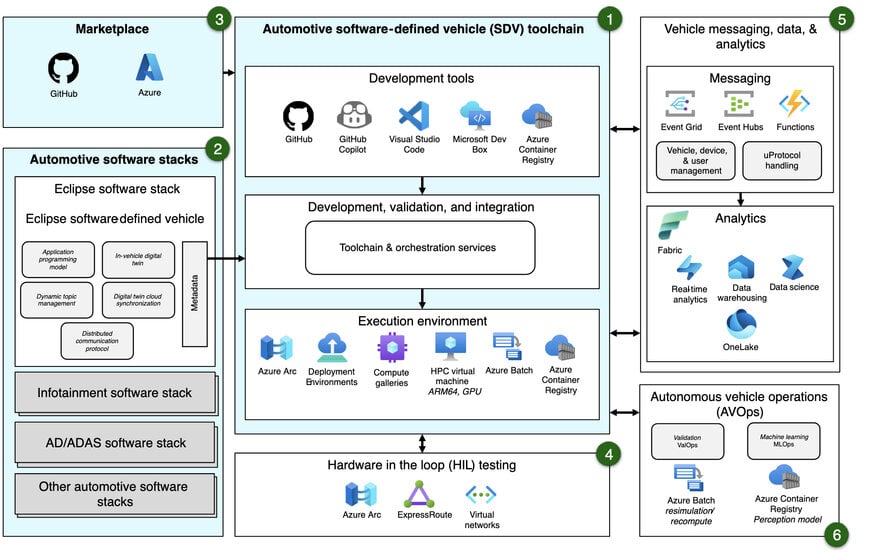
Synopsys addresses this through system-to-silicon virtualization, enabling software development, electronics integration, and validation to begin months before physical silicon is available. This “shift-left” engineering model supports continuous verification using electronics digital twins, aligning with emerging requirements in the digital supply chain where software updates, over-the-air deployment, and lifecycle services are integral to vehicle economics.
Simulation, Virtualization, and Measurable Impact
Central to the platform is large-scale system simulation that combines semiconductor models, vehicle electronics, and software workloads. Synopsys reports that virtualized design and validation can reduce prototyping and testing costs by 20–60%, depending on system complexity and program scale. Earlier system visibility also shortens release cycles and improves predictability at Start of Production.
A concrete example is the integration of Samsung’s ISOCELL Auto 1H1 image sensor into Ansys AVxcelerate Sensors software. The sensor model enables high-fidelity simulation of camera performance under variable lighting and traffic conditions, allowing perception algorithms to be evaluated without hardware. This supports standards-based safety validation workflows, including ISO 26262, before physical integration.
Application Areas and Industry Use Cases
The technologies target multiple automotive domains, including advanced driver assistance systems, autonomous driving stacks, in-vehicle infotainment, and centralized compute architectures. Semiconductor partners use virtual prototypes to validate SoC architectures, while OEMs apply system-level simulation to assess software behavior across multi-ECU environments.
Synopsys also announced support for the Fédération Internationale de l'Automobile, applying predictive digital human body models and design optimization tools to single-seater cockpit safety. These models process thousands of parameters to evaluate impact scenarios and ergonomics without physical crash testing, extending techniques developed for automotive safety into motorsport regulation.
Ecosystem Integration and Standards Alignment
At CES 2026, Synopsys demonstrated virtual development kits and multi-ECU simulations with ecosystem partners including Arm, NXP Semiconductors, and Texas Instruments. These environments enable early software bring-up, continuous integration pipelines, and validation aligned with SOAFEE and other industry frameworks.
Synopsys states that customers using its virtual development kits can achieve full system bring-up within days of silicon availability, compressing vehicle development timelines by up to 12 months. This capability is positioned as a key enabler for scalable software-defined vehicles operating within an increasingly interconnected automotive data ecosystem.
Positioning Within Automotive Engineering
Rather than introducing a single product, Synopsys is advancing a platform-based engineering methodology that integrates AI-assisted simulation, virtualization, and standards-driven validation. The relevance lies in measurable reductions in cost, time-to-market, and integration risk, addressing structural challenges faced by automotive manufacturers transitioning to software-centric vehicle architectures.
www.synopsys.com
