
www.ptreview.co.uk
07
'26
Written on Modified on
Robotic Palletizing with Digital Twin Integration
Universal Robots and Robotiq demonstrate a digitally simulated and physically deployed palletizing cell with Siemens at CES 2026 to illustrate data-driven automation design and operation.
www.universal-robots.com
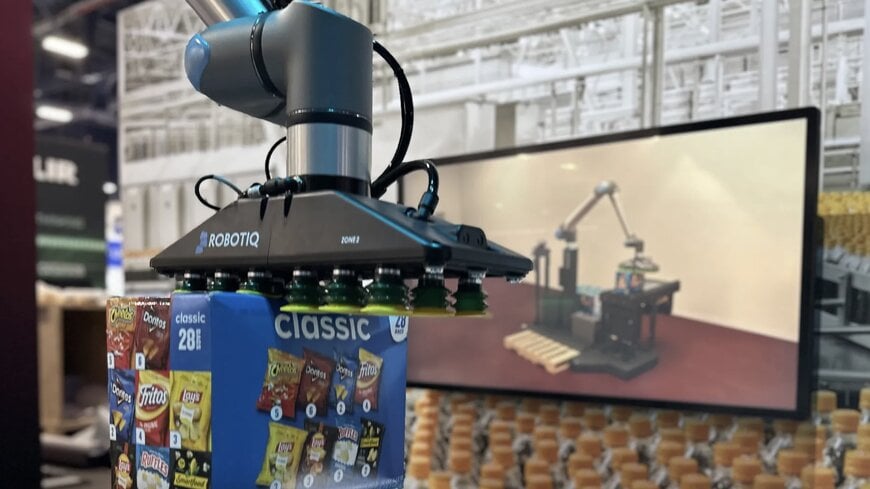
Universal Robots, part of Teradyne Robotics, and Robotiq have presented a collaborative robotic palletizing system that combines physical automation with real-time digital twin technology. Shown at CES 2026 in Las Vegas, the demonstration integrates a collaborative robot, a standardized palletizing cell, and Siemens’ automation and digital twin software to illustrate how manufacturers can design, validate, and optimize palletizing operations before and during deployment.
Addressing palletizing challenges in manufacturing
Palletizing remains a labor-intensive and variable process in many industries, particularly in food, beverage, and consumer goods production. Manufacturers face increasing pressure to automate these tasks while maintaining flexibility for changing product dimensions, packaging formats, and throughput requirements. Traditional palletizing systems often require long commissioning times and physical trial-and-error during setup.
The demonstrated solution addresses these challenges by combining collaborative robotics with a digital twin-based engineering workflow. The physical system consists of Universal Robots’ UR20 collaborative robot arm paired with Robotiq’s PAL Ready palletizing cell. This hardware setup is integrated with Siemens automation components and its newly introduced Digital Twin Composer software.
Digital twin-driven design and optimization
At the core of the demonstration is a real-time, photorealistic digital twin of the palletizing cell. Using Siemens’ Digital Twin Composer, the entire system is modeled and simulated in parallel with the live hardware. The digital twin mirrors robot motion, pallet patterns, gripper behavior, and cycle times, enabling validation of layouts and operating parameters without interrupting production.
During the CES demonstration, the system palletized boxes of food and beverage products. Digital twin analytics were used to dynamically adjust gripper suction points and handling strategies based on product characteristics. This approach allows engineers to test alternative configurations virtually and apply optimized parameters directly to the physical cell.
Role of industrial data and edge processing
Operational data is captured through Siemens Industrial Edge hardware and streamed to Siemens’ Insights Hub Copilot. This data pipeline provides real-time visibility into palletizing performance, including cycle efficiency, gripper utilization, and system behavior. By linking edge-level data acquisition with higher-level analytics, the system supports continuous optimization rather than static commissioning.
This architecture reflects a broader shift toward closed-loop automation, where simulation, execution, and analysis are tightly connected. The use of a digital twin reduces reliance on physical prototypes and shortens the time required to adapt palletizing systems to new products or production volumes.
Implications for industrial automation workflows
The joint demonstration highlights how collaborative robots, standardized automation cells, and digital twin software can be combined into a scalable automation framework. For manufacturers, this approach can reduce engineering effort, lower commissioning risk, and improve responsiveness to operational changes.
By aligning physical automation with real-time simulation and data analytics, the solution illustrates a practical pathway toward more flexible and data-driven production systems. While the demonstration focuses on palletizing, the same digital twin-based methodology can be extended to other material handling and assembly applications where variability and rapid changeover are critical factors.
www.universal-robots.com
