
www.ptreview.co.uk
23
'26
Written on Modified on
EasyWelder welding cobot keeps production running during changeovers
With the introduction of the EasyWelder, Teqram presents a new welding cobot cell specifically designed for metalworking companies that want to boost their welding capacity without losing flexibility.
teqram.com
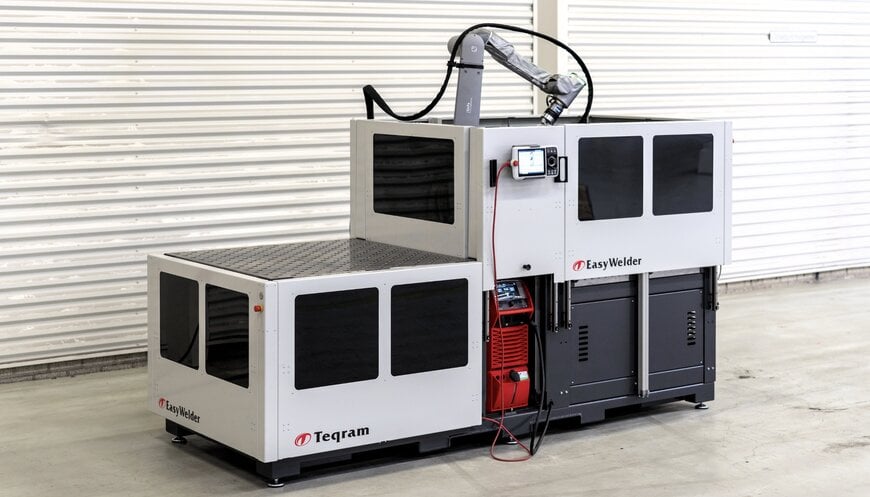
Teqram has introduced the EasyWelder, an automated dual-station collaborative welding cell designed to provide high-mix fabricators with flexible throughput and simplified manual path programming.
Process Automation and Operational Challenges
The EasyWelder is a modular collaborative robot (cobot) welding cell engineered for metalworking and subcontract fabrication environments to expand welding output without losing operational flexibility. The system integrates a dual-station configuration and an intuitive user interface to support highly variable product series and minimize changeover downtime. The product specifically addresses the challenges faced by fabrication shops encountering skilled labor shortages, highly variable component runs, and strict requirements for part quality and delivery schedules.
Dual-Station Architecture and Continuous Throughput
Standard automated welding setups lose substantial time during product changeovers and manual loading sequences. The EasyWelder uses a dual-station design containing two separate welding tables to maintain continuous production. While the robotic arm executes a weld path on one side of the workspace, the operator can safely load raw materials or unload a completed weldment on the adjacent side.
By removing the necessity to halt the robot during manual part extraction and replacement, the dual-station layout mitigates idle time. This continuous workflow increases the effective arc-on time of the cell up to 80% and establishes higher overall equipment utilization compared to single-table environments.
Adjustable Workspace and Protective Enclosure
The cell workspace features an automatic moving guard equipped with ultraviolet (UV) filtering windows, protecting nearby workers while the arm operates at maximum speed and maintaining a clear line of sight to the weld zone. The protective enclosure allows full access to both 1200 x 1200 mm welding tables from three sides to simplify part clamping. For oversized components, the partition between the two positions can be retracted to merge the separate workstations into a unified 2900 x 1200 mm production area.
Simplified Manual Path Programming and Interface Templates
The cell integrates an intuitive user interface and smart programming templates, enabling experienced welders to operate the automated cell without specialized robotics expertise or external offline programming tools. Common industrial welding procedures—including circular welds, stitch welding, tack welding, straight seams, and multi-pass joints—can be configured within a few minutes.
To program a new component path, the operator manually guides the cobot arm along the weld seam, recording path points via control buttons located directly on the robot head or an integrated selector ring. The internal software automatically generates the underlying execution code from these manual inputs, reducing total program development time by up to 70%. Operators can work independently with the cell following half a day of training.
Automated Joint Tracking and Precision Components
The system maintains consistent weld quality, reduces manual rework, and lowers reject rates by executing identical paths independent of operator fatigue. To adjust for component variations, the cell features an automatic weld seam detection and tracking system. Built upon three-dimensional vision technology, this real-time system gauges the exact position of the workpiece and joint geometry during execution, automatically altering the active path to compensate for part tolerances or clamping misalignments.
The hardware assembly standardizes on a combination of an ABB GoFa cobot arm and Fronius welding power sources. The cobot arm operates with a path accuracy of 0.03 mm and a maximum tool movement speed of 2.2 meters per second between positions to accelerate cycle times. The integrated power source provides arc stability to control spatter and thermal distortion when processing aluminum, stainless steel, and thin-gauge alloys.
Compact Geometry and Plug-and-Play Integration
With an overall footprint of 3100 x 1600 mm, the compact configuration requires minimal factory floor space and does not demand mechanical anchoring to the concrete floor. The standalone cell can be lifted and repositioned across a facility using a standard forklift to adapt to changing production demands. Commissioning relies on a plug-and-play setup, requiring only structural positioning and connection to shop electrical power, compressed air lines, and shielding gas supplies.
Additional Context
This section details technical specifications and competitive benchmarking not included in the original news release.
Collaborative robotic welding cells designed for small-to-medium enterprises and contract job shops are categorized by their spatial layout, programming method, and sensor integration. These systems aim to bridge the gap between flexible manual welding and fixed, high-volume industrial automation.
Workspace Kinematics and Volumetric Efficiency
Traditional entry-level cobot welding packages on the market utilize a single fixed table configuration, typically measuring 1500 x 1000 mm. In a single-station layout, the robot must stand completely idle for several minutes while an operator manually unclamps a finished part, cleans the fixture, and positions raw stock. This structural restriction limits the maximum achievable arc-on time of single-station product lines to roughly 40% to 55% of the total shift.
Transitioning the cell topology to a dual-zone layout featuring twin 1200 x 1200 mm work zones introduces parallel processing capability. The capability to merge these zones into a continuous 2900 x 1200 mm area provides an advantage over standard dual-zone turntable indexers or fixed-enclosure double-shuttle cells, which feature rigid central partitions that cannot be removed to accommodate long structural frames or elongated pipe assemblies.
Path Precision and Speed Thresholds
Rotor and joint articulation tolerances dictate the quality of precision gas metal arc welding (GMAW) and gas tungsten arc welding (GTAW). General market alternatives utilizing lighter-duty collaborative arms often deliver a path repeatability envelope of around 0.05 mm to 0.1 mm. Tightening this path accuracy boundary to 0.03 mm provides a distinct mechanical benefit when executing micro-welds or navigating tight fillet joints on thin sheet metal, where minor deviations can cause burn-through or insufficient throat thickness.
Furthermore, while basic cobot arms restrict linear air-cut transfer velocities to 1.0 meter per second to satisfy default collaborative safety force limits, utilizing a high-speed arm capable of 2.2 meters per second minimizes non-productive movement cycles. The inclusion of an automatic moving guard with integrated UV shielding enables the arm to exploit these higher velocities safely, bypassing the strict speed caps mandated for completely fenceless or open-table collaborative setups under standard safety specifications.
Program Creation and Lead-Through Usability
Standard industrial robot programming requires navigating complex coordinates via a proprietary hardware teach pendant or generating code via external offline programming software, a process that can take hours or days for multi-pass geometries. Lead-through or hand-guided teaching reduces this overhead by capturing coordinate vectors on the fly via force-torque sensors embedded in the arm joints.
By combining hand-guiding with specialized control buttons on the torch head and pre-programmed templates for complex movements like stitch and circular paths, the software removes the need to return to a separate tablet interface between path points. This localized control loop minimizes programming time compared to basic application-driven cobot setups that require manual data entry for parameter changes.
Sensor-Driven Path Compensation
A primary point of failure in automated job-shop welding is part-to-part variation, caused by inconsistent upstream laser cutting, bending tolerances, or manual clamping placement. Without adaptive sensing, a fixed-path robot will weld outside the joint groove, creating high scrap rates.
Traditional premium systems handle this variance using touch-sensing or through-arc seam tracking (TAST). However, touch-sensing adds non-productive cycle time by stopping to probe the part before each arc ignition, and TAST only functions on heavy-gauge materials with a distinct joint weave pattern. Utilizing three-dimensional vision technology allows the system to evaluate the weld joint profile in real time ahead of the arc. This optical tracking method provides continuous path correction on highly reflective or thin-gauge materials without extending cycle times or requiring physical contact with the workpiece.
Edited by Romila DSilva, Induportals Editor, with AI assistance.
www.teqram.com
