
www.ptreview.co.uk
17
'26
Written on Modified on
Rugged, compact and efficient - Liquid-cooled drives
ABB’s liquid-cooled drive technology increases power density, eliminates the need for air conditioning, and improves efficiency and reliability in space-constrained industrial and marine applications.
global.abb
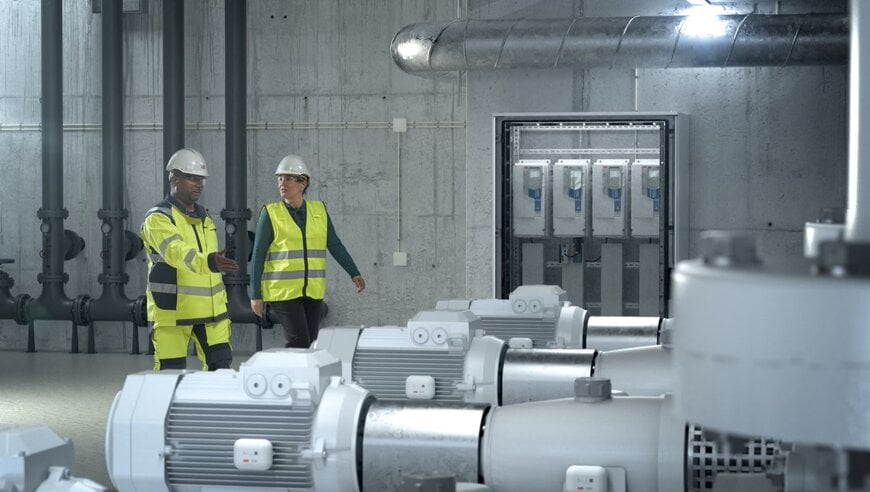
Have you ever wondered how a motor “knows” at what speed to turn? Or how much power to provide? Behind many motors are complex electrical devices called variable speed drives (VSD). The VSD assures precise speed and torque control of the motor, ensuring it runs as energy efficient as possible. Many heavier industrial applications, especially those requiring high power and compactness, use liquid-cooled drives.
There is hardly an application in industry that does not somehow use or rely on motors. Motors are used for pumping, lifting, cooling, mixing, rolling, winding, crushing, flattening, smoothing, milling, and many more jobs besides. Most of these applications require the motor to deliver a well-defined speed and torque to optimize both operational and energy efficiency. A motor running at the incorrect speed or torque can not only cause suboptimal production, but can disrupt other parts of the process, or cause strain on and damage to equipment. So how does one go about ensuring the motor always works at the required settings?
If an AC motor is connected directly to the grid through normal operational power supply (ie. it is simply plugged in and turned on), it will rotate at the speed imposed by the grid frequency, leaving little possibility for the user to customize its speed. Before the coming of drives, many applications had no choice but to accept a rather inefficient workaround. A pump, for example, would be run at a higher speed than the process required, and the flow of the fluid subsequently reduced using valves and baffle plates. This is highly wasteful use of energy can be likened to driving a car with the accelerator (and therefore the motor) permanently at full throttle while using the brakes to control the speed.
The coming of drives
In 1975, a team led by Martti Harmoinen working for Strömberg in Finland (a company that was later to become part of ABB) made a breakthrough with which Strömberg was later to become synonymous. The team worked out how to control motor speed by converting the fixed frequency they drew from the electrical grid into a variable frequency suitable for the motor.
The breakthrough low voltage technology is called pulse width modulation. Basically the drive unit outputs electrical pulses of varying widths that synthesize an electrical waveform. This was made possible by using power semiconductors. These semiconductors can switch large currents and voltages rapidly and without any moving parts, providing a low-loss and low-maintenance solution.
Early drives had one major drawback: their physical size. Strömberg’s first low voltage drive, the SAMI A, delivered 350 kVA but was the size of an average bedroom wardrobe. Today, a drive the size of a shoebox can do the same job. What was it that enabled drives to get smaller?
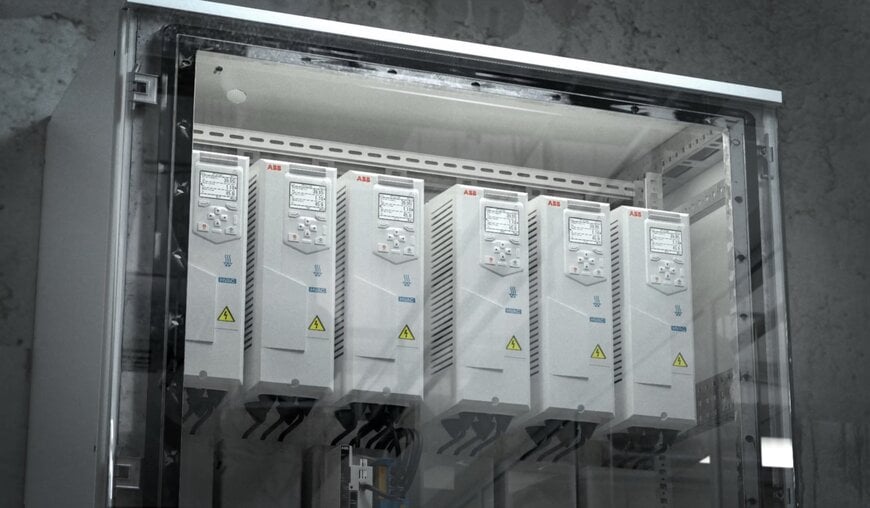
Liquid cooling
Whereas early drive units used air cooling, fluid cooling could remove excess heat much more effectively, permitting a more compact design. Eliminating the ducting and filters associated with air cooling furthermore reduces installation and maintenance complexity and thus operational costs.
ABB’s latest generation of liquid-cooled VSDs are up to 46% more compact than the previous generation, while their enclosed cabinet design makes them well suited for harsh environments such as mining, oil & gas, and marine where dust, humidity, high temperatures, or corrosive gases are present. The cooling system uses a globally available, ready-mixed Antifrogen® L coolant with corrosion protection, ensuring reliable operation, easy commissioning, and minimal maintenance. With quiet performance, marine approvals, and modular scalability, ABB’s liquid-cooled drives are built for uptime and long-term value.
ABB’s liquid-cooled drives enable industries working under exacting demands and harsh conditions to outrun, leaner and cleaner.
www.abb.com
