

www.ptreview.co.uk
09
'26
Written on
Modified on
NORD Drivesystems
Decentralised Drive Systems Target Intralogistics Efficiency
At LogiMAT 2026, NORD DRIVESYSTEMS will present modular drive architectures integrating safety functions and Ethernet connectivity for automated material handling applications.
www.nord.com
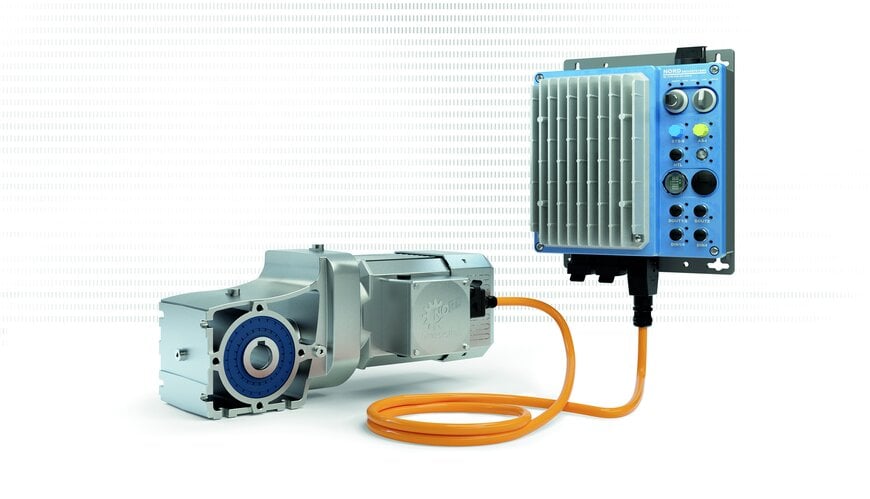
NORD will present the new NORDAC LINK variants – with Ethernet on board and extensive integrated functional safety
Energy efficiency and system availability remain central concerns in automated material handling, particularly as warehouses and parcel hubs increase throughput while managing operating costs. In this context, decentralised drive architectures are gaining traction as a way to simplify installation and improve scalability in industrial drive systems.
At LogiMAT 2026, taking place from 24 to 26 March in Stuttgart, Germany (Hall 3, Stand 3C41), NORD DRIVESYSTEMS will present updates to its decentralised drive portfolio, including new variants of the NORDAC LINK frequency inverter designed for networked intralogistics environments.
Ethernet connectivity and functional safety integration
The updated NORDAC LINK frequency inverter integrates onboard Ethernet connectivity to allow direct integration into existing automation networks. Communication interfaces support industrial protocols while safety integration is enabled through PROFIsafe and FSoE, allowing use in fail-safe automation architectures.
Drive-based functional safety features include STO (Safe Torque Off), SS1-t and SS1-r (Safe Stop 1 variants), SLS (Safely Limited Speed), SMS (Safe Maximum Speed), and SSM (Safe Speed Monitor).
Safe digital inputs and outputs allow direct connection of safety-related peripheral devices, reducing the need for additional safety controllers in some applications.
The system also supports encoderless control of permanent magnet synchronous motors using a Current Flux Control (CFC) open-loop method, allowing operation of IE5+ efficiency class motors in dynamic applications without additional feedback devices. This approach can reduce wiring complexity and component count in conveyor and sorting systems.
Energy efficiency and system availability remain central concerns in automated material handling, particularly as warehouses and parcel hubs increase throughput while managing operating costs. In this context, decentralised drive architectures are gaining traction as a way to simplify installation and improve scalability in industrial drive systems.
At LogiMAT 2026, taking place from 24 to 26 March in Stuttgart, Germany (Hall 3, Stand 3C41), NORD DRIVESYSTEMS will present updates to its decentralised drive portfolio, including new variants of the NORDAC LINK frequency inverter designed for networked intralogistics environments.
Ethernet connectivity and functional safety integration
The updated NORDAC LINK frequency inverter integrates onboard Ethernet connectivity to allow direct integration into existing automation networks. Communication interfaces support industrial protocols while safety integration is enabled through PROFIsafe and FSoE, allowing use in fail-safe automation architectures.
Drive-based functional safety features include STO (Safe Torque Off), SS1-t and SS1-r (Safe Stop 1 variants), SLS (Safely Limited Speed), SMS (Safe Maximum Speed), and SSM (Safe Speed Monitor).
Safe digital inputs and outputs allow direct connection of safety-related peripheral devices, reducing the need for additional safety controllers in some applications.
The system also supports encoderless control of permanent magnet synchronous motors using a Current Flux Control (CFC) open-loop method, allowing operation of IE5+ efficiency class motors in dynamic applications without additional feedback devices. This approach can reduce wiring complexity and component count in conveyor and sorting systems.
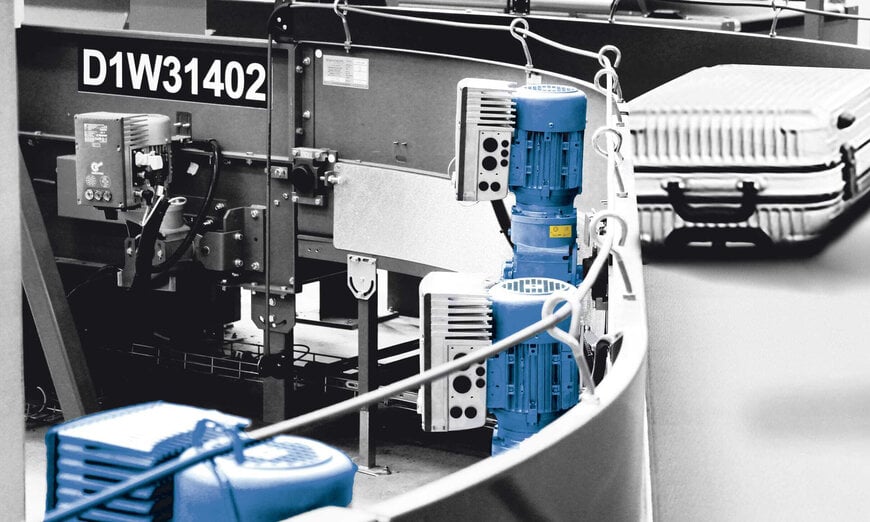
Decentralised drive electronics from NORD is the basis for energy- and cost-efficient conveyor systems in intralogistics
Modular drive configurations for conveyor and handling equipment
The NORDAC LINK wall-mounted inverter provides similar functionality to the motor-mounted NORDAC ON, both forming part of a modular decentralised drive platform compatible with IE3 asynchronous and IE5+ synchronous motors.
These drive electronics form part of the LogiDrive® modular system, which combines motors, gear units and decentralised variable frequency drives into pre-configured drive packages. The systems are intended for conveyor installations in parcel logistics, airport baggage handling and warehouse automation.
Two configurations are available:
Modular drive configurations for conveyor and handling equipment
The NORDAC LINK wall-mounted inverter provides similar functionality to the motor-mounted NORDAC ON, both forming part of a modular decentralised drive platform compatible with IE3 asynchronous and IE5+ synchronous motors.
These drive electronics form part of the LogiDrive® modular system, which combines motors, gear units and decentralised variable frequency drives into pre-configured drive packages. The systems are intended for conveyor installations in parcel logistics, airport baggage handling and warehouse automation.
Two configurations are available:
- LogiDrive® Advance, combining NORDAC LINK with IE5+ synchronous motors, is designed for energy optimisation across wide speed and load ranges, helping reduce the number of drive variants required for spare parts management.
- LogiDrive® Basic, based on NORDAC ON with IE3 asynchronous motors, focuses on compact installation and cost optimisation while maintaining high power density.
Such modularisation reflects an ongoing trend toward standardised power transmission architectures to simplify maintenance and spare parts logistics.
Energy optimisation through drive system analysis
Alongside hardware developments, NORD will also present its NORD ECO service for analysing energy consumption in existing installations. The approach involves measuring drive system loads and identifying optimisation opportunities through system redesign or drive replacement.
Previous optimisation projects have shown energy savings of up to 1165 kWh per year, equivalent to approximately six months of electricity consumption for a single-occupant household. This corresponds to an estimated reduction of about 466 kg of CO₂ emissions, based on typical electricity generation factors.
Such optimisation approaches reflect increasing industrial focus on improving drive efficiency as part of broader decarbonisation and operating cost reduction strategies in automated logistics environments.
www.nord.com
Energy optimisation through drive system analysis
Alongside hardware developments, NORD will also present its NORD ECO service for analysing energy consumption in existing installations. The approach involves measuring drive system loads and identifying optimisation opportunities through system redesign or drive replacement.
Previous optimisation projects have shown energy savings of up to 1165 kWh per year, equivalent to approximately six months of electricity consumption for a single-occupant household. This corresponds to an estimated reduction of about 466 kg of CO₂ emissions, based on typical electricity generation factors.
Such optimisation approaches reflect increasing industrial focus on improving drive efficiency as part of broader decarbonisation and operating cost reduction strategies in automated logistics environments.
www.nord.com
