
www.ptreview.co.uk
20
'26
Written on Modified on
ACNS utilizes Meltio wire-laser technology for monolithic parts with integrated cooling
The robot-integrated additive manufacturing cell replaces complex multi-part assemblies by depositing conformal cooling channels directly into the structure.
www.meltio3d.com
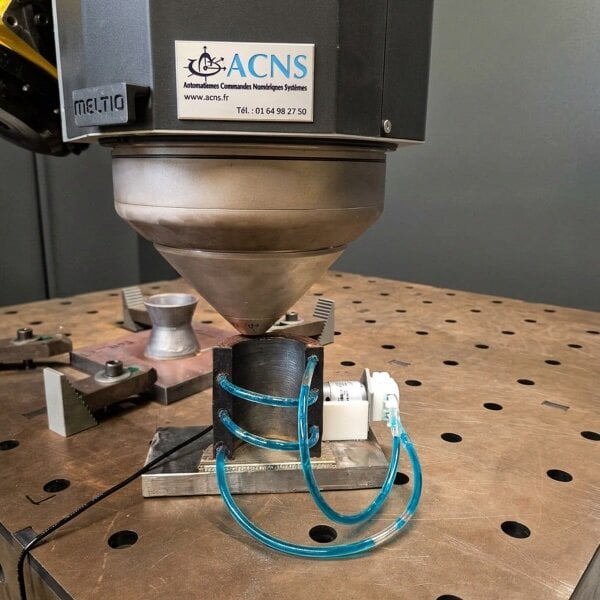
Automation and robotics integrator ACNS has deployed Meltio’s industrial metal wire-laser technology to manufacture a monolithic demonstrator part featuring built-in conformal cooling channels. By utilizing additive manufacturing (AM) to build thermal management channels directly into the structure during the deposition process, the company bypasses the geometric limitations of traditional drilling. This approach eliminates the need for intersecting drilled circuits, plugs, and sealed covers, drastically reducing potential leak paths and consolidating multi-part assemblies into a single monolithic unit.
Wire-laser deposition and open integration
When establishing its AM cell, ACNS opted for Meltio's laser-wire process over traditional powder-based systems or Wire Arc Additive Manufacturing (WAAM). Utilizing standard certified welding wire avoids the stringent safety, handling, and facility isolation requirements associated with reactive metal powders. Furthermore, substituting an electric arc with a precise laser heat source yields a finer weld bead and lower overall heat input, resulting in superior dimensional control and reducing the amount of stock material that must subsequently be machined away. Because the Meltio deposition head is integrated onto a standard industrial robot, such as a FANUC arm, the build envelope is constrained only by the robot’s maximum reach, allowing deposition and machining to be combined within the exact same manufacturing cell.
High-value applications and structural cost savings
While traditional methods like casting, forging, and subtractive machining remain the most viable options for high-volume mass production, the Meltio cell targets unit parts, small batches, and one-off tooling where conventional manufacturing struggles. In thermal management applications—such as cooling circuits for molds, energy housings, and fluid manifolds—conformal cooling becomes a pure design choice rather than a manufacturing compromise. The structural cost savings stem from eliminating secondary sealing operations, significantly reducing the part count, and minimizing material waste. Additionally, the same robotic cell can be deployed to repair and rebuild high-value worn components, extending equipment lifecycles without requiring a dedicated powder facility.
Additional Context: Conformal cooling and Wire-DED vs PBF
This section details technical specifications and competitive benchmarking not included in the original product announcement.
In traditional subtractive manufacturing, internal cooling channels must follow straight lines determined by the linear path of a drill bit. To cool complex geometries, engineers must drill intersecting cross-holes and permanently plug the external access points, creating inherent weak points susceptible to pressure leaks or corrosion over time. Conformal cooling solves this by wrapping the cooling channels three-dimensionally around the exact contours of the part, ensuring uniform heat dissipation and reducing thermal stress. While Powder Bed Fusion (PBF) technologies can also print conformal channels, they are typically limited to small build volumes inside a closed chamber and often struggle to extract unfused powder from winding internal fluid passages. Wire-laser Directed Energy Deposition (DED) mounted on a 6-axis robotic arm circumvents both issues: it scales to massive part dimensions and leaves no trapped powder inside the newly formed cooling circuits.
Edited by an industrial journalist, Lekshman Ramdas, with AI assistance.
www.meltio3d.com
