
www.ptreview.co.uk
16
'26
Written on Modified on
thyssenkrupp Automates Screwdriving with Universal Robots
UR30 cobots equipped with Inbolt 3D vision assemble combustion engines on a continuous moving line.
www.universal-robots.com
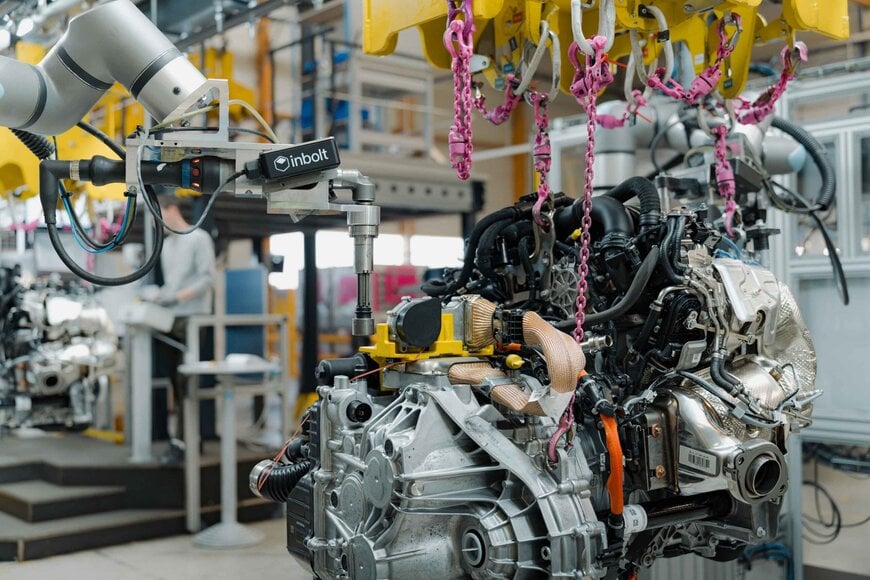
At its Herrlisheim facility in France, thyssenkrupp Automotive Systems France has automated a complex screwdriving operation on moving combustion engines using Universal Robots collaborative robots and 3D vision guidance from Inbolt. Integrated by RobotIndus, the solution enables two UR30-1300 cobots to operate directly on components suspended from an overhead conveyor without interrupting production flow. This automation eliminates severe ergonomic strains associated with overhead work and processes six engine variants with a non-compliant screwdriving rate of less than 1 percent.
3D Vision for Real-Time Trajectory Tracking
On the assembly line, suspended engines do not follow a perfectly fixed path and are subject to oscillation, rendering conventional 2D vision systems ineffective for determining exact depth and position. To overcome this, the Inbolt camera mounted on the cobot arm localizes each engine in six degrees of freedom by relying on the programmed CAD model of the part. This spatial position is transmitted in real-time to the robot controller, enabling it to dynamically correct its approach trajectory and perform screwdriving while the target continues to move.
Ergonomic Improvement and Future Expansion
Before deploying this robotic cell, operators performed these tightening tasks using electric screwdrivers in physically demanding postures that heavily strained their arms and shoulders. Transitioning to the UR30-1300 cobots, which are specifically tailored for high-torque screwdriving operations, eliminates this repetitive and taxing task. Building on this initial success, thyssenkrupp plans to scale the installation by adding a third and then a fourth robot equipped with Inbolt technology, with the long-term goal of integrating quality control operations without stopping the line.
Additional Context: Robotic Screwdriving on Overhead Conveyors (Line Tracking)
This section details technical specifications and competitive benchmarking not included in the original report.
In the automotive industry, stopping a main conveyor to perform an assembly operation creates bottlenecks that degrade the plant's overall cycle time. Traditional line tracking often relies on hardware encoders connected to the conveyor belt, assuming the part remains perfectly rigid on its support. However, on overhead skillet or pendulum conveyors, parts experience continuous pendulum motion that skews spatial coordinates. Integrating real-time 3D vision directly into the robot's servo-control loop enables adaptive "visual tracking." The system adjusts the robotic arm's kinematics at high frequency to compensate for the micro-movements of the floating target. Furthermore, utilizing high-payload cobots (a 30 kg payload for the UR30) allows the system to absorb the violent reaction torques generated during final tightening without requiring heavy mechanical reaction arms or caged safety fencing, thereby optimizing floor space on the shop floor.
Edited by industrial journalist Lekshman Ramdas, with AI assistance.
www.universal-robots.com
