
www.ptreview.co.uk
15
'26
Written on Modified on
PC-Based Automation for Multiphysical Turbine Material Test Benches
IABG and the DLR deployed Beckhoff PC-based control and EtherCAT measurement technology across four MTC test benches to simulate extreme engine operating conditions.
www.beckhoff.com
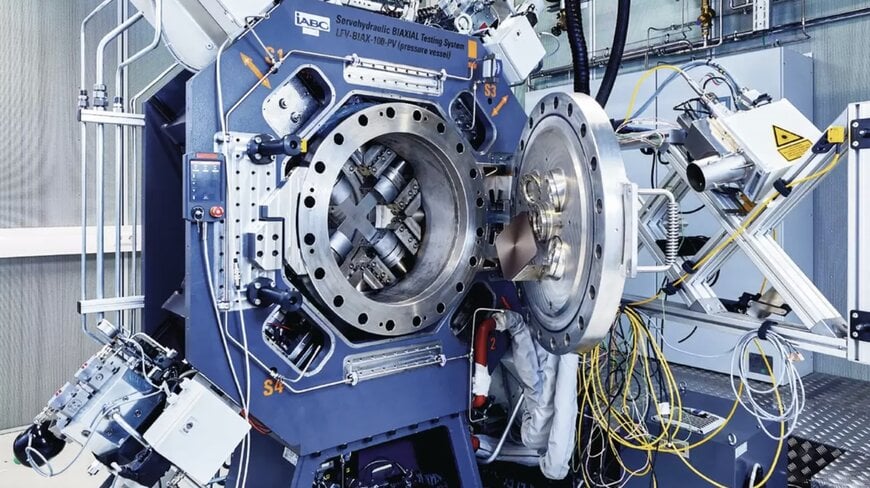
Application Areas: Test Bench Automation, Extreme Environment Simulation, Multiphysical Material Testing
Industry Sectors: Aerospace, Gas Turbine and Engine Manufacturing, Research and Development
The German Aerospace Center (DLR) Institute of Test and Simulation for Gas Turbines in Augsburg conducts fundamental material research to support future generations of turbine engines and validate virtual engine simulation models. Through an innovation partnership initiated in 2020, engineering firm IABG developed four specialized test benches to evaluate material samples under simultaneously acting mechanical, thermal, and chemical (MTC) loads:
- A planar biaxial hydraulic test bench
- A uniaxial hydraulic test bench
- A creep test bench
- A 1,000 Hz very-high-cycle fatigue test bench
Replicating realistic gas turbine operational profiles requires exposing test specimens to aggressive, precisely regulated environments. Material samples are mounted inside a pressure chamber subjected to pressures up to 20 bar and flooded with a synthetic mixture of clean gases (N2, O2, CO2, NO, CO, SO2) combined with water vapor. Simultaneously, a laser-based heating system raises specimen temperatures up to 1,400°C while mechanical actuators execute cyclic sinusoidal loading, standard Wöhler curves, or crack propagation sequences.
To coordinate these heterogeneous sub-systems, IABG required an open automation platform capable of deterministic real-time communication, synchronized high-speed data acquisition, and unified safety monitoring.
Deterministic Control and Synchronized Measurement Architecture
IABG implemented a distributed control structure utilizing two dedicated Beckhoff controllers interconnected via an EL6692 EtherCAT Bridge terminal. An Embedded PC CX5140 executes the central automation, sequencing, and test room monitoring logic, while a CX2043 Embedded PC processes the high-speed analog measurement technology. This physical separation isolates the core machine control from measurement configuration changes and creates processing capacity to execute future DLR MATLAB®/Simulink® models directly on the measurement hardware.
High-precision signal acquisition is managed via specialized EtherCAT terminals positioned directly at the test chambers to shorten analog wiring runs:
To coordinate these heterogeneous sub-systems, IABG required an open automation platform capable of deterministic real-time communication, synchronized high-speed data acquisition, and unified safety monitoring.
Deterministic Control and Synchronized Measurement Architecture
IABG implemented a distributed control structure utilizing two dedicated Beckhoff controllers interconnected via an EL6692 EtherCAT Bridge terminal. An Embedded PC CX5140 executes the central automation, sequencing, and test room monitoring logic, while a CX2043 Embedded PC processes the high-speed analog measurement technology. This physical separation isolates the core machine control from measurement configuration changes and creates processing capacity to execute future DLR MATLAB®/Simulink® models directly on the measurement hardware.
High-precision signal acquisition is managed via specialized EtherCAT terminals positioned directly at the test chambers to shorten analog wiring runs:
- High-Speed Load Acquisition: Four-channel ELM3004 voltage measurement terminals digitize analog signals (±10 V) from the load frame controllers (forces, positions, displacements, and torques) at 10 ksamples/s. Operated over a 1 ms PLC cycle, a tenfold oversampling factor yields dynamic mechanical profiling without overloading IPC processor capacity.
- Universal Measurement: Multifunctional ELM3704 terminals provide decentralized signal conditioning for secondary process variables.
- Time-Synchronous Telemetry: TwinCAT consolidates disparate sensor inputs based on sub-microsecond EtherCAT distributed clock timestamps, outputting a unified process image combining temperature, pressure, gas mixtures, and physical load vectors.
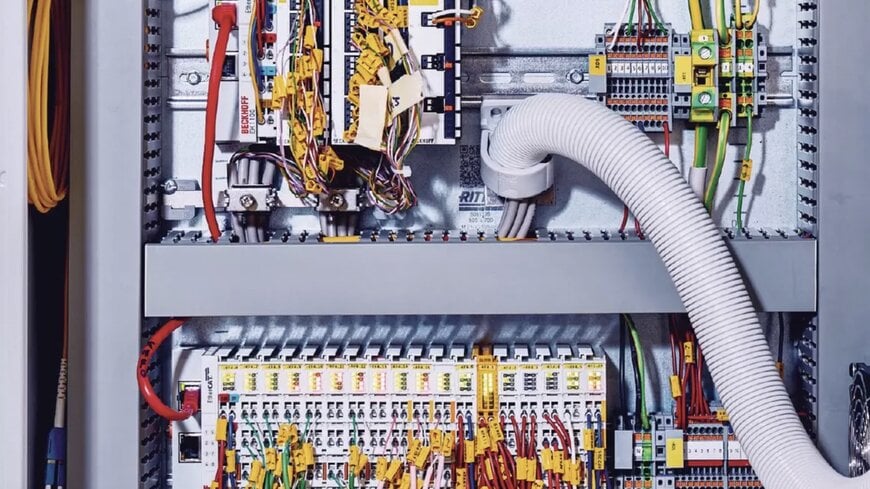
In large part, the measurement data and I/O signals are acquired directly at the test chambers and transmitted to the controllers via EtherCAT.
Integrated Safety and Multi-Vendor Networking
Given that individual material test sequences run unsupervised for multiple weeks, safety integration was a critical technical requirement. IABG integrated TwinSAFE SC (Single Channel) terminals—including EL3314-0090 thermocouple and EL3214-0090 RTD units—to evaluate the critical temperatures of laser traps and beam containment tubes using standard PT100 resistors and thermocouples. Door interlocks across the individual testing suites are networked via EtherCAT P and Fail Safe over EtherCAT (FSoE), consolidating power and fail-safe communication over a single cable.
EtherCAT interfaces directly with the laser controllers, while third-party hardware integration is accommodated via PROFINET RT and TCP protocols through EtherCAT bus couplers. From the central control room, operators coordinate test runs, set test parameters, and configure EtherCAT I/O slices through a LabVIEW™ interface communicating via TwinCAT ADS (Automation Device Specification) and CAN over Ethernet (CoE) using the Beckhoff TF3710 interface software.
Future iterations planned by the DLR and IABG involve leveraging OPC UA communication to introduce dynamic real-time adjustments to load cycles during operation, enabling bidirectional hardware-in-the-loop simulation between virtual turbine flight models and physical bench hardware.
Edited by Romila DSilva, Induportals Editor, with AI assistance.
Given that individual material test sequences run unsupervised for multiple weeks, safety integration was a critical technical requirement. IABG integrated TwinSAFE SC (Single Channel) terminals—including EL3314-0090 thermocouple and EL3214-0090 RTD units—to evaluate the critical temperatures of laser traps and beam containment tubes using standard PT100 resistors and thermocouples. Door interlocks across the individual testing suites are networked via EtherCAT P and Fail Safe over EtherCAT (FSoE), consolidating power and fail-safe communication over a single cable.
EtherCAT interfaces directly with the laser controllers, while third-party hardware integration is accommodated via PROFINET RT and TCP protocols through EtherCAT bus couplers. From the central control room, operators coordinate test runs, set test parameters, and configure EtherCAT I/O slices through a LabVIEW™ interface communicating via TwinCAT ADS (Automation Device Specification) and CAN over Ethernet (CoE) using the Beckhoff TF3710 interface software.
Future iterations planned by the DLR and IABG involve leveraging OPC UA communication to introduce dynamic real-time adjustments to load cycles during operation, enabling bidirectional hardware-in-the-loop simulation between virtual turbine flight models and physical bench hardware.
Edited by Romila DSilva, Induportals Editor, with AI assistance.
