
www.ptreview.co.uk
27
'26
Written on Modified on
Decentralized Motion Control for Large-Scale Sheet Metal Processing
KEBA supplied a modular drive architecture to solve critical space constraints and complex multi-axis synchronization on extended industrial production lines.
www.keba.com
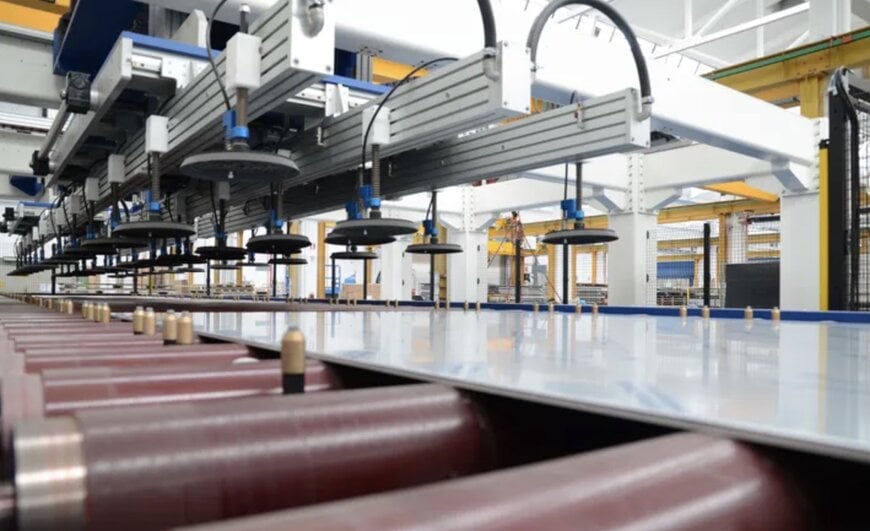
META production lines extend up to 80 meters in length – with some installations going even beyond.
Automazioni Meta srl, a designer of industrial feeding systems, collaborated with control automation provider KEBA to restructure the motion control management for extensive sheet metal handling lines. The resulting deployment of decentralized, multi-axis drives successfully resolves complex synchronization and cabinet footprint challenges within the heavy industrial automation sector.
Complex Handling Requirements in Sheet Metal Processing
Automazioni Meta srl (META) specializes in the design of complete feeding systems and handling equipment for belt sanding machines used in sheet metal processing. End users in the automotive, food, and chemical industries require the processing of large, heavy stainless steel plates with strict tolerances for surface quality and planarity. The equipment must operate across production lines that measure up to 80 meters in length. Handling these massive plates requires the coordination of up to 60 independent axes. Standardized, centralized control management becomes highly inefficient at this scale, leading to excessive cabling, signal degradation, and overly large electrical cabinets. To accommodate a growing industrial demand for systems capable of executing different types of surface finishing on a single production line, the manufacturer needed to establish a highly standardized mechanical and electronic base.
Designing a Decentralized Control Architecture
To address these space and configuration challenges, the engineering team prioritized the unification of brushless motors and their relative drives to simplify both machine design and subsequent maintenance. The manufacturer selected a customized motion control architecture based on a modular drive system.
Fabrizio Rossetto, Technical Engineer, details the engineering challenge: "We needed to figure out how to handle the large and heavy plate sizes, carefully taking into consideration the planarity and quality of the surface. To meet this requirement, we developed a centralized control architecture based on a single controller and four decentralized control cabinets distributed along the production line."
The deployed architecture utilizes the KeDrive D3 modular system. The setup integrates 23 multi-axis drives operating approximately 60 motors in a coordinated sequence. Centralizing the motion sequences, drive configurations, and machine logic is an EtherCAT-based controller running on an open-standard automation platform, which also provides wide interfacing capabilities with other line controllers and plant networks.
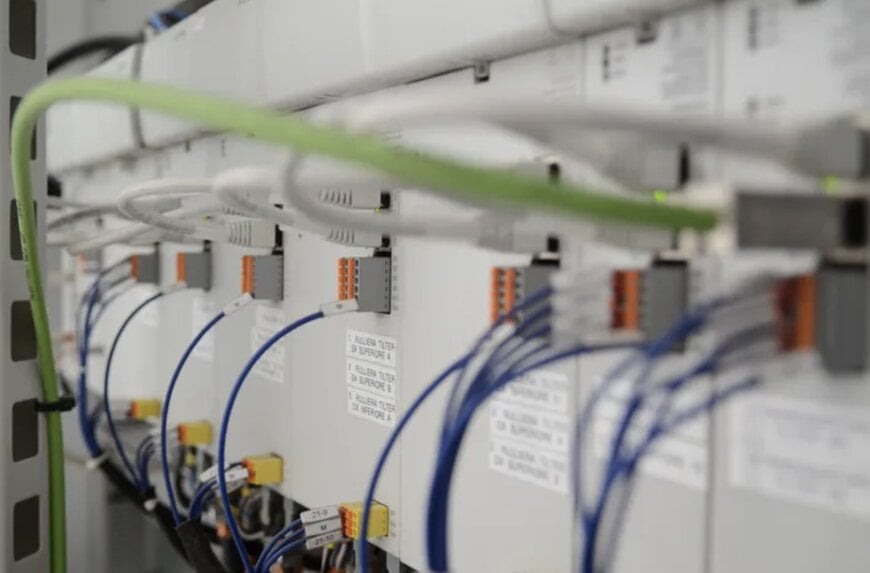
KeDrive D3: a modular system that, thanks to its 3-axis drive module, drastically reduces the number of physical components and the space required in control cabinets.
Optimizing Space and Cabling
The primary factor driving the selection of this specific hardware was its architectural flexibility and physical compactness. The integration of a specialized tri-axis module into the drive system drastically reduced the overall number of physical components required to manage the high axis count.
"On 80-meter lines, centralized management is inefficient; the chosen architecture allows us to distribute the drives into several electrical cabinets located along the line, optimizing space, cabling, and costs," explains Leonardo Minatel, Chief Mechanical Designer at META.
By utilizing decentralized nodes instead of routing all 60 axes back to a single central hub, the system minimizes the required hardware footprint on the factory floor.
Quantifiable Operational Benefits
The transition to a distributed, multi-axis drive system yielded immediate structural and logistical improvements for the machine builder. Minatel notes the physical space savings: "Managing over 60 axes with other suppliers would have led to control cabinets twice as large and a much more burdensome and complex spare parts management."
The reduction in physical components translates directly to fewer potential failure points and a streamlined inventory for replacement parts. Moving forward, the equipment designs will integrate brushless motors equipped with electronic nameplates for automatic recognition, aiming to further simplify initial commissioning procedures. Additionally, the integrated condition monitoring functions within the drives provide a continuous database on axis performance, enabling end-users to implement highly accurate predictive maintenance schedules.
Edited by Aishwarya Mambet, Induportals Editor, with AI assistance.
www.keba.com
Automazioni Meta srl, a designer of industrial feeding systems, collaborated with control automation provider KEBA to restructure the motion control management for extensive sheet metal handling lines. The resulting deployment of decentralized, multi-axis drives successfully resolves complex synchronization and cabinet footprint challenges within the heavy industrial automation sector.
Complex Handling Requirements in Sheet Metal Processing
Automazioni Meta srl (META) specializes in the design of complete feeding systems and handling equipment for belt sanding machines used in sheet metal processing. End users in the automotive, food, and chemical industries require the processing of large, heavy stainless steel plates with strict tolerances for surface quality and planarity. The equipment must operate across production lines that measure up to 80 meters in length. Handling these massive plates requires the coordination of up to 60 independent axes. Standardized, centralized control management becomes highly inefficient at this scale, leading to excessive cabling, signal degradation, and overly large electrical cabinets. To accommodate a growing industrial demand for systems capable of executing different types of surface finishing on a single production line, the manufacturer needed to establish a highly standardized mechanical and electronic base.
Designing a Decentralized Control Architecture
To address these space and configuration challenges, the engineering team prioritized the unification of brushless motors and their relative drives to simplify both machine design and subsequent maintenance. The manufacturer selected a customized motion control architecture based on a modular drive system.
Fabrizio Rossetto, Technical Engineer, details the engineering challenge: "We needed to figure out how to handle the large and heavy plate sizes, carefully taking into consideration the planarity and quality of the surface. To meet this requirement, we developed a centralized control architecture based on a single controller and four decentralized control cabinets distributed along the production line."
The deployed architecture utilizes the KeDrive D3 modular system. The setup integrates 23 multi-axis drives operating approximately 60 motors in a coordinated sequence. Centralizing the motion sequences, drive configurations, and machine logic is an EtherCAT-based controller running on an open-standard automation platform, which also provides wide interfacing capabilities with other line controllers and plant networks.
KeDrive D3: a modular system that, thanks to its 3-axis drive module, drastically reduces the number of physical components and the space required in control cabinets.
Optimizing Space and Cabling
The primary factor driving the selection of this specific hardware was its architectural flexibility and physical compactness. The integration of a specialized tri-axis module into the drive system drastically reduced the overall number of physical components required to manage the high axis count.
"On 80-meter lines, centralized management is inefficient; the chosen architecture allows us to distribute the drives into several electrical cabinets located along the line, optimizing space, cabling, and costs," explains Leonardo Minatel, Chief Mechanical Designer at META.
By utilizing decentralized nodes instead of routing all 60 axes back to a single central hub, the system minimizes the required hardware footprint on the factory floor.
Quantifiable Operational Benefits
The transition to a distributed, multi-axis drive system yielded immediate structural and logistical improvements for the machine builder. Minatel notes the physical space savings: "Managing over 60 axes with other suppliers would have led to control cabinets twice as large and a much more burdensome and complex spare parts management."
The reduction in physical components translates directly to fewer potential failure points and a streamlined inventory for replacement parts. Moving forward, the equipment designs will integrate brushless motors equipped with electronic nameplates for automatic recognition, aiming to further simplify initial commissioning procedures. Additionally, the integrated condition monitoring functions within the drives provide a continuous database on axis performance, enabling end-users to implement highly accurate predictive maintenance schedules.
Edited by Aishwarya Mambet, Induportals Editor, with AI assistance.
www.keba.com
