
www.ptreview.co.uk
05
'26
Written on Modified on
Selecting Switching Devices for Industrial Power Systems
LS ELECTRIC America explains how engineers can improve electrical system reliability through correct selection of contactors and relays.
www.lselectricamerica.com
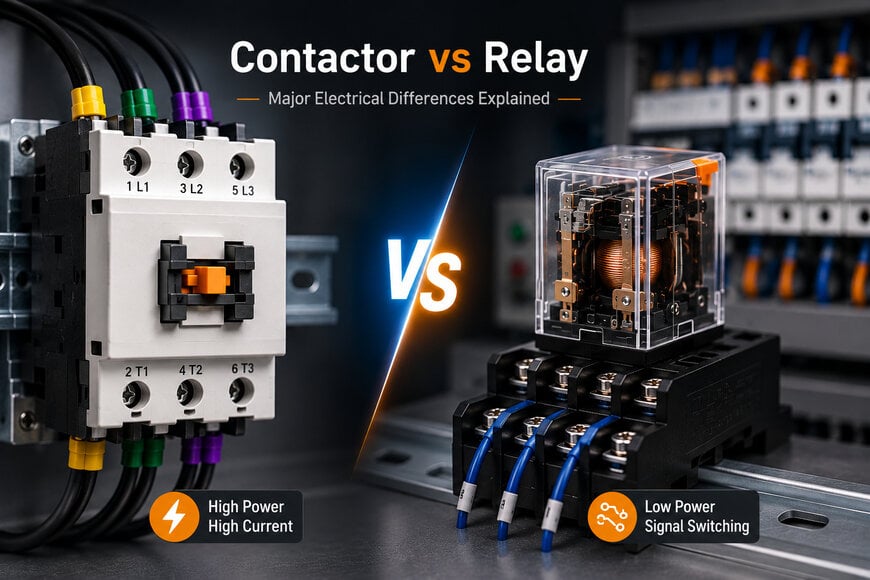
Application Areas: Industrial automation, motor control, electrical power systems
Industry Sectors: Manufacturing, HVAC, industrial facilities, infrastructure
Industrial facilities rely on switching devices to control motors, automation equipment, HVAC systems, and power distribution infrastructure. Selecting the appropriate switching technology is essential for maintaining operational reliability, equipment protection, and system safety. Understanding the differences between contactors and relays helps engineers and facility operators match device capabilities to application requirements.
The Challenge of Managing Different Electrical Loads
Industrial and commercial facilities operate equipment with widely varying electrical demands. While control systems such as PLCs and sensors require low-power switching, motors, compressors, pumps, and heating systems often involve high-current loads and frequent switching cycles.
Using an incorrectly specified switching device can lead to premature component wear, equipment failures, unplanned downtime, and increased maintenance requirements. Engineers therefore need to evaluate load characteristics, operating conditions, and control requirements before selecting a switching solution.
Matching the Solution to the Application
The recommended approach depends primarily on the type and magnitude of the electrical load.
Contactors are designed for high-current and high-voltage applications. Their construction includes heavy-duty contacts, reinforced insulation, and arc-suppression systems that allow them to safely switch demanding electrical loads. These characteristics make contactors suitable for industrial motors, compressors, conveyors, pumps, HVAC equipment, and power distribution systems.
Relays, by comparison, are intended for low-to-medium power circuits, signal switching, and control logic applications. They provide electrical isolation between control systems and load circuits while supporting flexible contact configurations. Their compact size allows installation in control panels, automation systems, and electronic equipment where space is limited.
Technical Considerations Behind Device Selection
Electrical load capacity remains one of the most important selection criteria. Applications involving currents above approximately 15 amperes or three-phase motor loads typically require contactors due to their ability to withstand high inrush currents and frequent switching operations.
For lower-current applications such as sensors, control circuits, PLC outputs, valves, and communication interfaces, relays provide adequate performance while reducing installation space requirements.
Switching frequency is another important factor. Equipment that cycles repeatedly throughout production shifts places significant stress on switching components. Contactors are specifically designed for these conditions through integrated arc-management systems that reduce contact wear and heat generation.
Relays are better suited to applications with lower switching demands and where precise signal control or circuit isolation is the primary requirement.
Supporting Reliable Industrial Operations
The selection process also requires consideration of control voltage requirements. Industrial facilities commonly use 24 VDC control circuits for PLC-based automation systems, while larger installations may use 120 VAC, 240 VAC, or higher control voltages depending on system architecture.
Engineers must also consider auxiliary feedback requirements. Relays often provide multiple contact arrangements within a single device, while contactors may require auxiliary contact blocks to deliver operational feedback to monitoring and control systems.
Operational Benefits
Correctly matching contactors and relays to their intended applications contributes to improved equipment reliability and reduced maintenance requirements.
Contactors support reliable operation of high-power equipment by managing electrical arcing and repetitive switching loads. Their design helps extend service life in demanding industrial environments.
Relays contribute to system protection by isolating sensitive control electronics from power circuits and enabling accurate signal management within automation systems. Their compact construction also supports efficient control panel design.
According to Chris Rhodes, Product Specialist, Power Components at LS ELECTRIC America Inc., understanding load characteristics and switching requirements is essential when selecting electrical control devices, particularly as industrial automation systems become increasingly interconnected and complex.
Conclusion
The choice between a contactor and a relay depends on load current, voltage requirements, switching frequency, and overall system architecture. Contactors are generally preferred for high-power applications involving motors and heavy industrial equipment, while relays remain suitable for signal control, automation logic, and lower-power switching tasks.
Proper device selection helps facilities improve electrical system reliability, protect connected equipment, and reduce the risk of unplanned downtime across industrial automation and power distribution applications.
Edited by Sucithra Mani, Induportals editor – adapted by AI.
www.lselectricamerica.com
