
www.ptreview.co.uk
29
'26
Written on Modified on
KUKA Robot Automates Laboratory Testing Workflows
Anton Paar integrates robotic handling into rheometer-based quality testing to improve throughput, reproducibility, and continuous operation in laboratory automation environments.
www.kuka.com
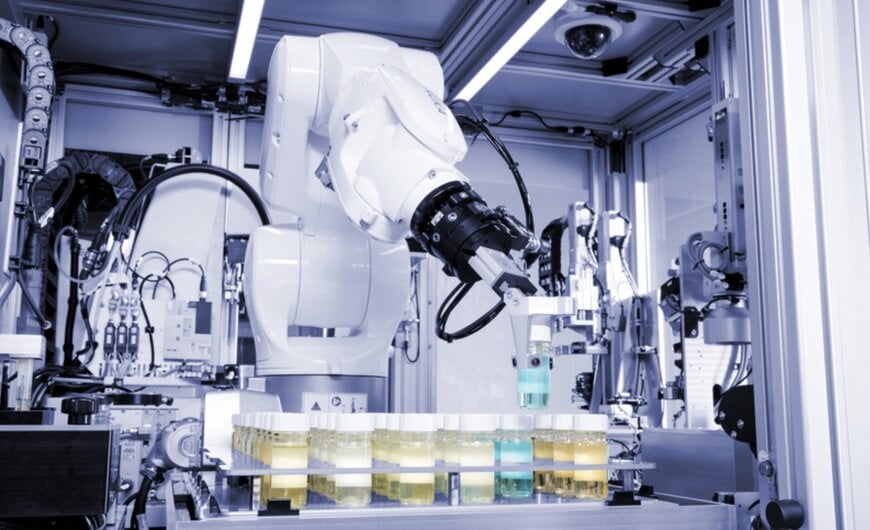
Photo Credit: Anton Paar
Laboratory testing in sectors such as food, beverages, and cosmetics involves repetitive sample handling tasks that can limit throughput and consistency. In this context, KUKA has deployed its KR AGILUS robot within automated rheometer systems at Anton Paar GmbH to support continuous sample processing and analysis.
From manual handling to continuous sample processing
The KR AGILUS is integrated into the automated rheometer HTR 7000, where it manages sample placement, device positioning, and post-test handling. Designed as a compact 6-axis robot with a payload capacity of 6 kilograms and a reach of 726 millimeters, it operates within confined laboratory environments requiring precise and repeatable motion.
Applications include testing of solid, viscous, and liquid-dosable samples, particularly in food quality control. By automating these steps, the system reduces reliance on manual intervention in routine laboratory workflows.
Eliminating process gaps in laboratory automation
Integration of the robot into the testing system removes 14 manual process steps. This reduces idle time associated with waiting between test stages and allows laboratory personnel to focus on setup and data evaluation tasks.
Continuous operation enables routine processes to run with consistent execution, improving reproducibility and enabling better comparability of test results across different facilities. This aligns with broader trends in laboratory automation and digital supply chain integration, where standardized data and repeatable processes are required.
Precision handling supports repeatable test conditions
Within the HTR 7000 system, the KR AGILUS performs multiple functions, including sample handling, cleaning of measurement equipment, documentation generation, and disposal of tested materials. Its ESD certification, compact footprint, and motion accuracy support stable operation in laboratory environments with strict handling requirements.
The automated system can process up to 60 samples within a 24-hour cycle. While a hygienic machine configuration was not required for this deployment, such variants are available for applications with stricter environmental or regulatory constraints.
Scaling robotic integration across laboratory applications
Approximately ten automated systems incorporating the KR AGILUS are deployed globally across industries including cosmetics and brewing. Additional applications are under evaluation, particularly in food and beverage testing, where similar sample handling and measurement workflows exist.
The collaboration between KUKA and Anton Paar includes both robotic systems and software integration, enabling deployment within existing laboratory infrastructures. Selection criteria for the automation solution included precision, reliability, system compatibility, and global service availability to support distributed installations.
Toward broader adoption of laboratory robotics
The integration of robotic handling into analytical instruments such as rheometers demonstrates how automation can standardize repetitive laboratory tasks while maintaining consistent test conditions. Further deployments are expected to extend this approach to additional testing scenarios, supporting higher throughput and more consistent data generation in laboratory environments.
Edited by Aishwarya Mambet, Induportals Editor, with AI assistance.
www.kuka.com
Laboratory testing in sectors such as food, beverages, and cosmetics involves repetitive sample handling tasks that can limit throughput and consistency. In this context, KUKA has deployed its KR AGILUS robot within automated rheometer systems at Anton Paar GmbH to support continuous sample processing and analysis.
From manual handling to continuous sample processing
The KR AGILUS is integrated into the automated rheometer HTR 7000, where it manages sample placement, device positioning, and post-test handling. Designed as a compact 6-axis robot with a payload capacity of 6 kilograms and a reach of 726 millimeters, it operates within confined laboratory environments requiring precise and repeatable motion.
Applications include testing of solid, viscous, and liquid-dosable samples, particularly in food quality control. By automating these steps, the system reduces reliance on manual intervention in routine laboratory workflows.
Eliminating process gaps in laboratory automation
Integration of the robot into the testing system removes 14 manual process steps. This reduces idle time associated with waiting between test stages and allows laboratory personnel to focus on setup and data evaluation tasks.
Continuous operation enables routine processes to run with consistent execution, improving reproducibility and enabling better comparability of test results across different facilities. This aligns with broader trends in laboratory automation and digital supply chain integration, where standardized data and repeatable processes are required.
Precision handling supports repeatable test conditions
Within the HTR 7000 system, the KR AGILUS performs multiple functions, including sample handling, cleaning of measurement equipment, documentation generation, and disposal of tested materials. Its ESD certification, compact footprint, and motion accuracy support stable operation in laboratory environments with strict handling requirements.
The automated system can process up to 60 samples within a 24-hour cycle. While a hygienic machine configuration was not required for this deployment, such variants are available for applications with stricter environmental or regulatory constraints.
Scaling robotic integration across laboratory applications
Approximately ten automated systems incorporating the KR AGILUS are deployed globally across industries including cosmetics and brewing. Additional applications are under evaluation, particularly in food and beverage testing, where similar sample handling and measurement workflows exist.
The collaboration between KUKA and Anton Paar includes both robotic systems and software integration, enabling deployment within existing laboratory infrastructures. Selection criteria for the automation solution included precision, reliability, system compatibility, and global service availability to support distributed installations.
Toward broader adoption of laboratory robotics
The integration of robotic handling into analytical instruments such as rheometers demonstrates how automation can standardize repetitive laboratory tasks while maintaining consistent test conditions. Further deployments are expected to extend this approach to additional testing scenarios, supporting higher throughput and more consistent data generation in laboratory environments.
Edited by Aishwarya Mambet, Induportals Editor, with AI assistance.
www.kuka.com
