
www.ptreview.co.uk
21
'26
Written on Modified on
Robotic palletizing reduces cardboard use in cheese packaging
Salas O’Brien and Rockwell Automation deliver a fully integrated system to eliminate packaging waste and improve efficiency.
www.rockwellautomation.com
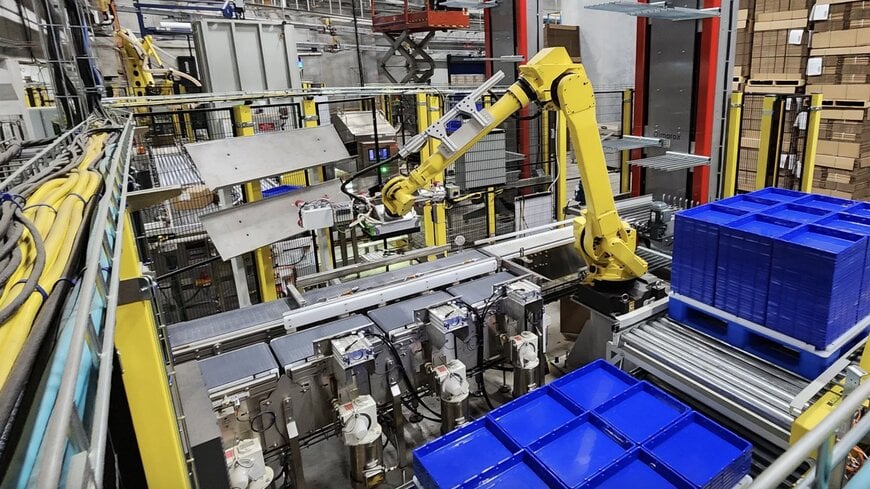
A major dairy producer based in Wisconsin sought to modernize its facility with two primary objectives: enhancing environmental sustainability and optimizing site logistics. The central challenge involved the heavy reliance on cardboard boxes for packaging and shipping large cheese blocks. This traditional method required extensive on-site storage and generated significant waste for downstream customers.
Transitioning away from cardboard introduced specific technical hurdles. Cheese blocks undergo dimensional changes during the cooling process, which complicates robotic handling. Standard grippers often struggle to secure wrapped products of varying sizes without compromising the plastic seal integrity or damaging the cheese. Furthermore, the manufacturer required this transition to occur within the existing facility footprint without interrupting ongoing production schedules.
Technical Solution and Unified Control Architecture
The project was managed by Salas O’Brien, an EPC and system integrator partner of Rockwell Automation. To navigate the spatial constraints, engineers utilized simulation software to model equipment placement and sequencing before physical installation. The deployment was executed in phases, primarily during scheduled Sunday closures, to ensure zero downtime for the main production lines.
The selected solution replaced cardboard boxes with a reusable tray-based system. The technical core of the installation included:
- Robotic handling: Dedicated arms designed to manage pre-wrapped cheese blocks with high precision.
- Automated systems: Integrated palletizing, restacking, tray loading/offloading, and block labeling units.
- Unified Control: The system utilizes a single control architecture where robotic motion, safety, and line controls are embedded in the same controllers as the broader process automation.
Salas O’Brien utilized standard templates for variable speed drives and servo systems to accelerate the commissioning process. By employing a safety controller with standardized code, the team streamlined the programming of custom robotic zones and safety functions.
Quantifiable Results in Sustainability and Efficiency
The implementation of the robotic palletizing system and the removal of cardboard from the production cycle yielded immediate operational gains. The facility eliminated the need for approximately 8,500 pounds of cardboard per day, significantly reducing procurement costs and reclaiming valuable warehouse floor space.
Beyond material savings, the precision of the new robotic grippers addressed the product integrity issues associated with cooling cheese. By providing more consistent handling than previous methods, the system reduced cheese waste by approximately 200 pounds per day.
Operational Value and Strategic Outcomes
The integration of robotic controls directly into the primary automation controllers simplified the technical environment for plant operators. This unified approach eliminates the need for separate robotic programming, which facilitates faster troubleshooting and simplifies long-term maintenance.
The project demonstrated that large-scale smart building systems and automation upgrades can be integrated into existing food processing layouts to achieve a high return on investment through both waste reduction and improved product yield.
Edited by Romila DSilva, Induportals Editor, with AI assistance.
Quantifiable Results in Sustainability and Efficiency
The implementation of the robotic palletizing system and the removal of cardboard from the production cycle yielded immediate operational gains. The facility eliminated the need for approximately 8,500 pounds of cardboard per day, significantly reducing procurement costs and reclaiming valuable warehouse floor space.
Beyond material savings, the precision of the new robotic grippers addressed the product integrity issues associated with cooling cheese. By providing more consistent handling than previous methods, the system reduced cheese waste by approximately 200 pounds per day.
Operational Value and Strategic Outcomes
The integration of robotic controls directly into the primary automation controllers simplified the technical environment for plant operators. This unified approach eliminates the need for separate robotic programming, which facilitates faster troubleshooting and simplifies long-term maintenance.
The project demonstrated that large-scale smart building systems and automation upgrades can be integrated into existing food processing layouts to achieve a high return on investment through both waste reduction and improved product yield.
Edited by Romila DSilva, Induportals Editor, with AI assistance.
