
www.ptreview.co.uk
30
'26
Written on Modified on
Ernst Reiner automates CNC production with robotic cells
EGS Automation and Yaskawa robots enable flexible series production and stable processes under high product variability.
www.yaskawa.eu.com
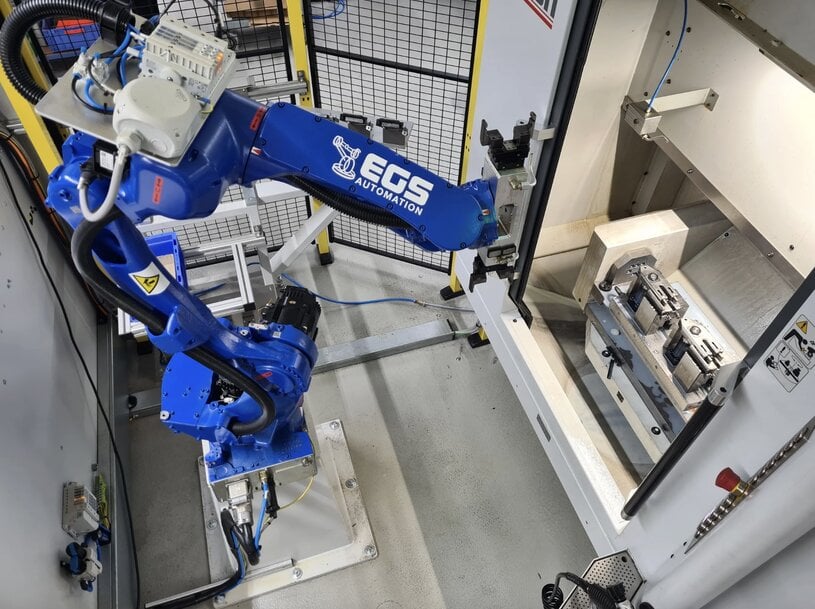
Ernst Reiner GmbH & Co. KG is a family-owned company based in Furtwangen. Originally known for manufacturing stamps, the company has evolved into a provider of mobile marking systems, scanners and precision engineering services.
Within its precision engineering division, Ernst Reiner produces medium batch sizes ranging from 1,000 to 100,000 parts per year. Its capabilities include sheet metal processing, machining, and technologies such as injection molding, die casting and metal injection molding.
However, increasing product variety and decreasing batch sizes exposed the limits of earlier in-house automation concepts. At the same time, skilled labor shortages and the need for unattended shifts created demand for more flexible and robust automation.
Requirements for adaptable automation
The company sought an automation solution that could adapt to varying part geometries and production processes while maintaining efficiency and process stability. Seamless integration into existing machinery and ease of operation were also key requirements.
After evaluating multiple options, Ernst Reiner selected EGS Automation, based on technical expertise, proximity and a collaborative approach.
Retrofitting automation into existing CNC operations
The first robotic cell was integrated with an existing CNC machining center that had previously been manually loaded. The solution was designed to allow both automated and manual operation, ensuring flexibility for small batches and setup tasks.
While adapting the existing machine—particularly converting clamping systems for automation—required more effort than anticipated, the integration of the robotic system itself proceeded smoothly, supported by practical training for operators.
The system fully automates loading and unloading. Raw parts are picked from carriers, aligned at a regripping station and temporarily stored. Before loading new parts, finished components and fixtures are cleaned using compressed air to remove chips and coolant, ensuring process reliability.
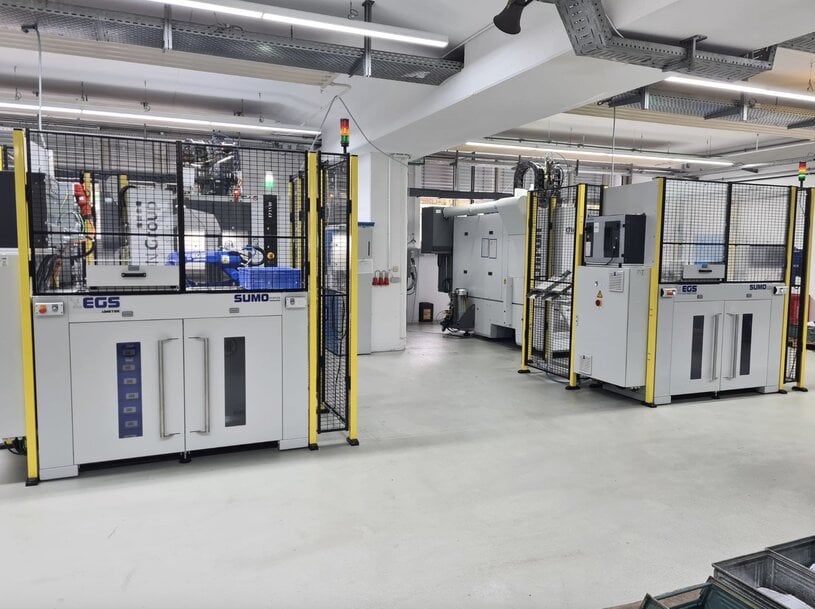
Standardized handling with industrial robots
Material handling is performed by a six-axis robot from Yaskawa, selected for its compact footprint, reach and payload capacity.
Parts are supplied in standardized small load carriers (KLT), equipped with part-specific sheet metal inserts to ensure precise positioning. This enables consistent and repeatable handling by the robot.
The carriers are stacked and fed into a palletizing system, allowing multiple trays to be buffered. Depending on part type and cycle time, the system can operate autonomously for a full shift, a full day or even an entire weekend.
Scalable automation across production
Following the successful deployment of the first system, two additional, nearly identical robotic cells were installed on new machines. Integration was again completed without major challenges.
Ernst Reiner has also begun building internal robotics expertise, using dedicated systems for testing and development. A further automation project is already underway: a robotic cell for injection molding that will automate the full process chain, from insert handling and part removal to inspection and packaging.
Supporting long-term competitiveness
Automation at Ernst Reiner is part of a broader strategic approach aimed at reducing dependence on manual labor, stabilizing processes and maintaining competitiveness.
By combining modular automation, standardized handling systems and close collaboration with partners, the company has established a flexible production environment capable of adapting to changing requirements while ensuring consistent quality and efficiency.
Edited by Romila DSilva, Induportals Editor, with AI assistance.
www.yaskawa.eu.com
