
www.ptreview.co.uk
24
'26
Written on Modified on
Flexible energy supply reduces downtime risks in paint lines
Procon Systems implements a robotic solution at SEAT to refine painted surfaces and minimize costly downtime through advanced energy chain systems.
www.igus.eu
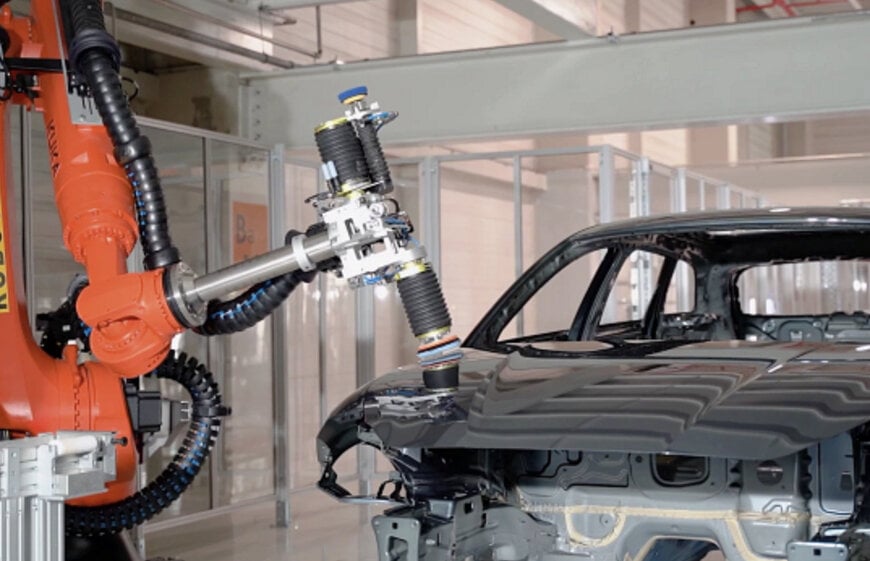
In automotive manufacturing, unplanned downtime results in significant financial losses. According to the study “The True Cost of Downtime 2024,” these costs average 2.3 million US dollars per hour. Against this backdrop, the Spanish engineering company Procon Systems developed an automated system for a SEAT production plant to perform post-paint surface finishing.
The objective was to detect and correct paint imperfections fully automatically after the coating process. In addition to ensuring consistently high surface quality, the main priorities were process stability and the prevention of unplanned production stops.
Automated finishing in two robotic cells
The implemented solution consists of two robotic cells arranged in series, each equipped with six-axis articulated robots. After painting, vehicle bodies are transported via a conveyor system into the first cell.
There, an industrial robot inspects the surface using a vision system. If a defect is detected, it is processed in several steps: first, deionized water is applied to the affected area, followed by sanding. The body then moves to the second cell, where another robot removes sanding residues and performs polishing.
This application requires highly precise movements and the ability to reach every point on the vehicle body.
Challenge: Mechanical stress on cables
The complex three-dimensional movements of the robots generate significant mechanical stress on cables and pneumatic hoses running between the robot base and the end effector. Unlike standard automation tasks, the tools must not only reach predefined positions but operate freely across the entire surface.
Any cable failure would immediately lead to production downtime. Ensuring reliable energy and media supply was therefore a critical aspect of the system design.
Solution: Energy chains for multidirectional motion
To secure cable routing, Procon Systems selected energy chains made of high-performance plastic. These consist of modular, spherical joint chain links that allow movement in multiple axes.
This design enables cables and hoses to follow the robot’s three-dimensional movements in a controlled manner, reducing torsion and mechanical wear. An integrated retraction system ensures that the energy chain remains close to the robot arm, preventing sagging or twisting.
Oriol Morè Roca, Head of Industrial Automation at Procon Systems, explains: “The robot arms can reach any point thanks to the flexible energy supply, without concerns about cable failures.”
Results and operational benefits
The use of flexible energy chains significantly reduces the risk of cable damage and associated downtime, directly improving system availability and process reliability.
In addition, the solution ensures consistent surface finishing quality, as the robots can perform complex movements without restriction. The combination of automated defect detection and precise reworking enhances the efficiency of the entire paint line.
Matthias Meier, Managing Director of igus Spain, adds: “The partnership demonstrates how technological solutions can increase efficiency and precision in industrial automation.”
Conclusion
This implementation highlights the growing importance of robust energy supply systems in highly dynamic robotic applications. Particularly in automotive manufacturing, where downtime has major financial implications, such solutions contribute to the stability and scalability of automated production processes.
Edited by Maria Brueva, Induportals editor – adapted by AI.
www.igus.com
