
www.ptreview.co.uk
18
'26
Written on Modified on
Rollon Enables Compact High-Speed Palletizing Automation
Custom linear systems support fast, space-constrained palletizing for food packaging with optimized cycle times, payload handling, and flexible system integration.
www.rollon.com
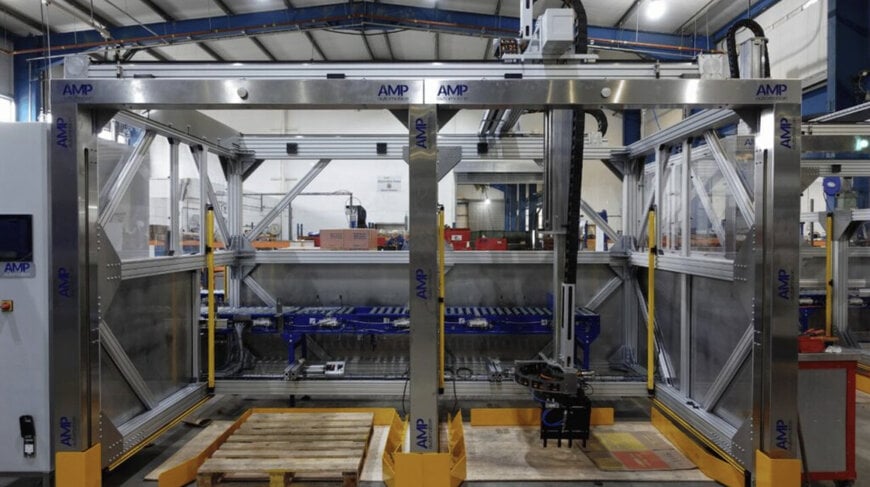
Food processing and packaging automation, particularly in pet food and fast-moving consumer goods, increasingly requires compact, high-throughput palletizing systems capable of handling varying payloads. Rollon supported AMP Automation in developing a palletizing solution for a UK-based pet food packaging line, integrating customized linear motion systems to meet strict spatial and performance constraints.
The project focused on automating end-of-line palletizing, where boxed products are sorted, transferred, and stacked onto pallets with minimal manual intervention while maintaining continuous operation.
High-speed palletizing under constrained space conditions
The palletizing system processes boxes of dog food in three formats—8 kg, 16 kg, and 20 kg—requiring flexible handling by robotic units. Products are conveyed through taping and sorting stages before being distributed between two robotic palletizing stations operating in parallel. Each robot alternates between two pallet bays, enabling uninterrupted loading and pallet exchange.
A key requirement was achieving a cycle time of 7.5 seconds per box and completing a full pallet stack in under six minutes. To meet this throughput, the system evolved from a single gantry to a mirrored dual-gantry configuration, improving load distribution and operational efficiency.
However, installation in a refrigerated environment introduced significant design constraints. Limited vertical clearance due to insulated ceiling panels restricted the use of standard telescopic systems, requiring a re-engineered approach to vertical motion.
Custom telescopic axis and linear actuator integration
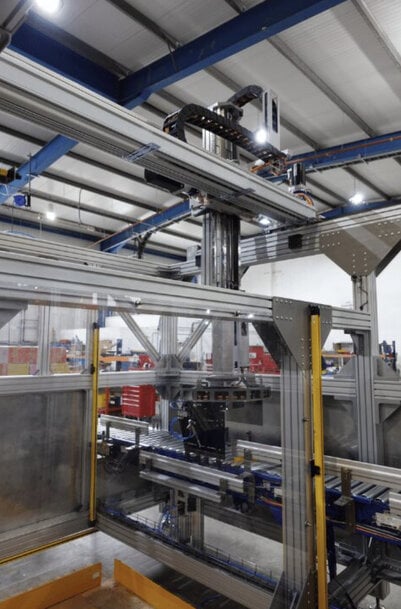
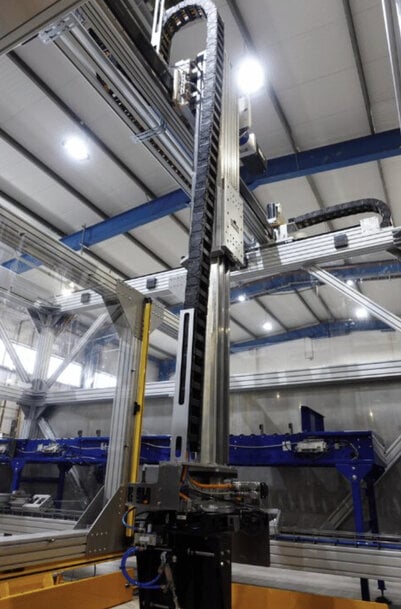
To address these constraints, Rollon developed a modified version of its Telescopic System TLS 230 for the Z axis, reducing the system height by approximately 25–30 cm. This dimensional adjustment was critical to enable installation within the available headspace while maintaining the required stroke and load capacity.
In parallel, E-Smart linear actuators were selected for the X and Y axes to support the required acceleration and payload handling. These actuators were sized to ensure consistent performance under high duty cycles, which is essential for continuous palletizing operations in automated packaging lines.
An additional engineering challenge involved the cable chain configuration. During vertical extension, conventional setups would increase the system’s height footprint. By integrating the cable chain with the Z-axis actuator, the design preserved compactness without compromising functionality or reliability.
Application in automated food packaging lines
The solution is designed for secondary and tertiary packaging processes in the food industry, including pet food, bakery, frozen, and chilled product lines. Its ability to handle multiple box sizes and weights within a single system makes it suitable for mixed-product environments where flexibility is required.
The automated palletizing system reduces manual handling, improves consistency in stacking patterns, and supports higher throughput compared to manual or semi-automated alternatives. In temperature-controlled environments, such automation also limits operator exposure to refrigerated conditions.
Engineering approach and scalability
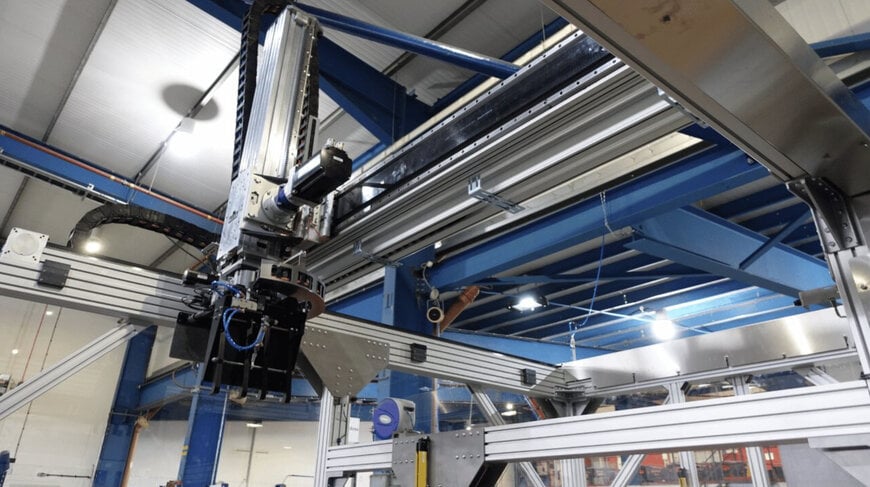
The system demonstrates how customized linear motion solutions can address integration challenges in confined industrial environments. By adapting standard components to specific dimensional and performance requirements, the design achieves both compactness and operational speed.
Compared with conventional palletizing systems that rely on standard gantry or robotic configurations, this approach emphasizes modularity and replicability. The gantry-based palletizer can be standardized for similar applications, enabling faster deployment across multiple production lines.
The collaboration between system integrator and component supplier highlights the importance of co-engineering in automation projects, particularly when balancing mechanical constraints, cycle time requirements, and reliability in continuous operations.
Edited by Industrial Journalist, Natania Lyngdoh — Adapted by AI.
www.rollon.com
