
www.ptreview.co.uk
05
'26
Written on Modified on
The model factory explores the potential of a collaborative robot equipped with a computing module
SmartFactory-KL, the model factory dedicated to research and demonstration of production technologies, is exploring the capabilities of Yaskawa's NHC12 collaborative robot, which incorporates an Nvidia-based computing module.
www.yaskawa.eu.com
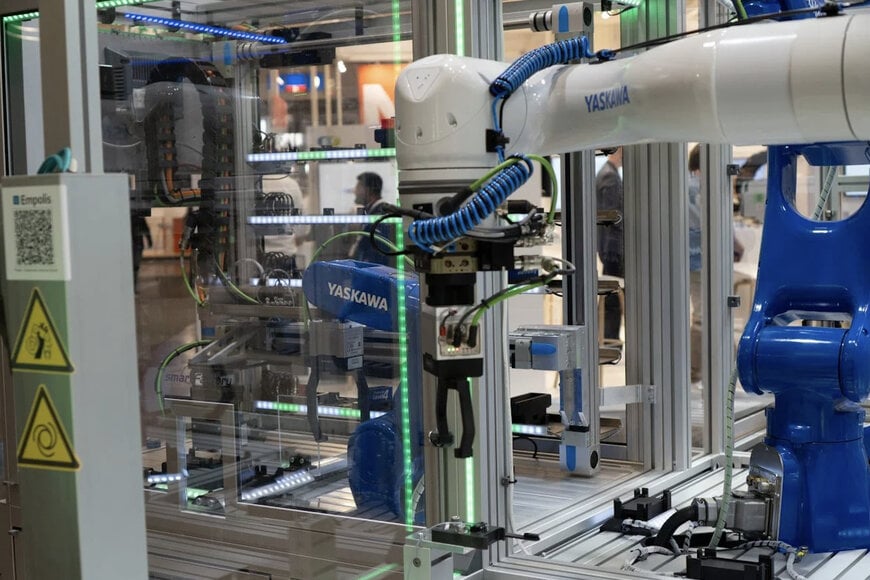
At the research site SmartFactory-KL, multiple robots are used to research and demonstrate industrial automation. The aim of the project was to integrate a robot that could be controlled not only with traditional robot languages but also via modern high-level languages and graphical programming environments, supporting adaptive and intelligent functions.
To achieve this, SmartFactory-KL chose the collaborative robot NHC12 from Yaskawa, which can perform both classic robotic tasks and flexible computing processes on an integrated edge system.
SmartFactory-KL is a real model factory that demonstrates current and future production technologies. Integrating a robot with high-level language support and autonomous function execution aligned with the goal of further developing digital reference architectures for the Smart Factory.
Technical Solution: NHC12 Cobot with Integrated Edge Computing
The NHC12 is a collaborative robot with a payload of up to 12 kg and high-resolution torque sensing, certified for safe human-robot collaboration without protective fences. Unlike classic industrial robots that are mainly programmed with proprietary languages like INFORM, the NHC12 allows control via graphical programming languages and common high-level languages such as Python or C++.
An NVIDIA-based edge computing module integrated into the robot controller enables applications like AI-powered image processing to run directly on the robot without external computers. The computing power allows parameterizable functions (“skills”) to run autonomously in the robot control system. This means tasks can be flexibly adapted in real time based on sensor data, such as from vision systems.
Reasons for Choosing This Solution
SmartFactory-KL selected the NHC12 because of the combination of collaborative safety functions, flexible programming options, and integrated computing power. The ability to program the robot with high-level languages and integrate application logic directly into the controller opens new approaches for adaptive automation and integration into Smart Factory reference architectures.
The integrated safety features, such as force and torque sensing control, can be used within the skills and allow direct cooperation with humans—for example in pick-and-place tasks or handing over workpieces—without additional protective equipment.
Implementation and Integration
The integration of the NHC12 into the SmartFactory-KL test environment was facilitated by prior experience with Yaskawa robots. Many robot functions could be developed in simulation with a digital twin even before physical delivery.
After installation, the system was showcased at trade fairs, including a demonstration at Hannover Messe 2025 and the official product launch at Automatica in June 2025 as part of a production cell.
This combination of digital pre-development and phased commissioning shortened the start-up time and enabled early validation of the robot in a realistic factory environment.
Results and Benefits
Although specific performance figures are not mentioned, several objective advantages can be identified:
- Increased programming flexibility: Tasks can be developed with common programming languages and graphical tools, reducing integration effort and enabling new use cases.
- Autonomous operation: Thanks to integrated computing power and sensor-based skills, the robot can recognize part variants and perform tasks with minimal external control.
- Human-robot collaboration: Certified safety features allow close cooperation with operators in research and industrial environments.
- Efficient integration: Simulation and digital twin support rapid commissioning and continuous evaluation of software updates.
These characteristics support SmartFactory-KL’s goals by demonstrating a flexible, adaptive robot system aligned with Smart Factory principles.
Michael Klos, General Manager of Robotics Division at Yaskawa Europe, said collaboration with SmartFactory-KL helps validate new robotics technologies in practical settings and evaluate their usefulness in digital Smart Factory concepts.
Benjamin Blumhofer from SmartFactory-KL emphasized that integrating the NHC12 into the reference architecture further concretized the Smart Factory concept through real application.
www.yaskawa.com
Michael Klos, General Manager of Robotics Division at Yaskawa Europe, said collaboration with SmartFactory-KL helps validate new robotics technologies in practical settings and evaluate their usefulness in digital Smart Factory concepts.
Benjamin Blumhofer from SmartFactory-KL emphasized that integrating the NHC12 into the reference architecture further concretized the Smart Factory concept through real application.
www.yaskawa.com
